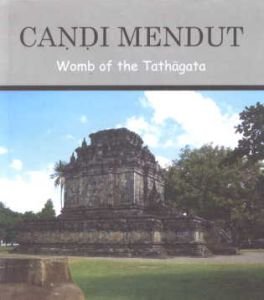
Candi Mendut : Womb of the Tathagata
Contents: List of illustrations. Key to footnote abbreviations. Key to the Reliefs and images at Candi Mendut. Foreword. Introduction. Acknowledgements. 1. A descriptive survey of the temple. 2. Mendut's environs. 3. Mendut's organizing principle. 4. The Reliefs on the foot of the Cella. 5. The Reliefs on the exterior partition walls. 6. Inside the vestibule. 7. Inside the Cella: a detailed hypothesis. 8. Astrological symbolism of Mendut and Pawon. 9. Dimensional symbolism of the Javanese Temple. 10. The Javanese Temple as heaven's mirror. Appendixes: i. The state of Old Mataram. ii. Glossary of Sanskrit words. iii. Bibliography. Index.
"This Candi Mendut is a reflection of the sublime and stupendous Indrajala of the Javanese people when they attained unprecedented heights of power, when literary genius blossomed in their language of Javanese, when they enriched their lovely island with monumental structures that evoke wonder after twelve centuries, even in their ruined state. Mark Long has endeavored to interpret one of these celestial jewels, which reflects the many-splendored mind of the Indonesian people in their unique vision of compassion (Maitri of Maitreya) in the virtue of creative action. When the Buddhas of the Ten Directions patted Samantabhadra, their hands were adorned with marks of greatness. Likewise, the ocean of vows, images and concepts of the enlightened teachings enshrined in Mendut emit light and fragrance in this wondrous presentation of Mark Long, who has delved into the textual realms as well as in the infinite cosmos of astronomy, cosmology and aesthetics.
This work by Mark Long continues his creative dimension of understanding the Candis of Indonesia as cosmic symbols of sovereignty that encode astronomical perceptions of the auspicious. In his study of the Borobudur, along with Caesar Voute, he blazed a new trail of inquiry, and found long-sought answers for resolving some doubts. Mark Long's present work on Candi Mendut is yet another milestone that deserves serious attention as it provides materials required for conducting a detailed study of the Mendut Temple, as well as a number of points in need of further investigation. This is a book that will provoke and inspire scholars to rethink many issues.
Often overlooked because of its close proximity to the world famous Borobudur, Candi Mendut was widely regarded by the early Dutch scholars as ranking among the most shining architectural jewels produced by the remarkable civilization that emerged in Central Java during the eighth century." (jacket)
