Comprehensive History and Culture of Andhra Pradesh Vol. IV. Medieval Andhradesa AD 1000-1324
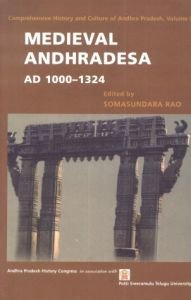
Contents: Preface. Acknowledgements. I. Transition/C. Somasundara Rao. II. Age of regional powers: 1. The Chalukyas of Kalyana/K.S. Kameswara Rao. 2. The Chalukya Cholas/J. Durga Prasad. 3. The Velanati Chodas.V. Sundararama Sastry. 4. The Haihayas of Palanadu/V. Sundarama Sastry. 5. The Telugu Chodas of Nellore/C.A. Padmanabha Sastry. 6. The Yadavarayas/D. Kirankranth Choudary. 7. The Kandur Chodas/N.S. Ramachandra Murthy. 8. Chalukya Lineages in Vengi Desa/K. Suryanarayana. 9. The later Gangas (AD 1038-1327)/C.V. Ramachandra Rao. 10. Historical Geography/N.S. Ramachandra Murthy and N. Krishna Reddy. III. Kakatiya Supremacy and unification of Andhra: 1. The Kakatiyas/P.V. Parabrahma Sastry. 2. Kakatiya Polity and nature of the state/I. Lakshmi. 3. The law and legal institutions/P.V. Parabrahma Sastry and N.S. Ramachandra Murthy. IV. Society and economy: 1. Society and economy of Telangana/B. Pramila. 2. Society and economy of Vengidesa/Aruna Pariti. 3. Society and economy of Rayalasima and Nellore/N. Krishna Reddy. 4. Society and economy in Kalinga/N.S. Ramachandra Murthy. 5. Temple economy/K.S. Kameswara Rao and K. Suryanarayana. 6. Urbanization/Aruna Pariti. 7. Coinage/G. Kamalakar. V. Matrix of culture: 1. Saivism/D. Kiran Kranth Choudary. 2. Vaishnavism/O. Sambaiah. 3. Jainism/G. Jawaharlal. 4. Jainism in Perumbanappadi/A.R. Ramachandra Reddy. 5. Sakta and Tantric cults/N. Krishna Reddy. 6. Pilgrimage tradition/B. Rajendra Prasad, D. Kiran Kranth Choudary, N. Krishna Reddy and J. Ramanaiah. 7. Popular culture/P.S. Kanaka Durga. 8. Medicine/P. Hymavati. 9. Evolution of the Telugu script/P.V. Parabrahma Sastry and N.S. Ramachandra Murthy. 10. Language and literature/N.S. Raju. 11. Music and dance/Anuradha Jonnalagadda. 12. Art/D. Kirankranth Choudary. 13. Defence architecture/N.S. Ramachandra Murthy. 14. Temple architecture/B. Rajendra Prasad and A. Gurumurthy. Abbreviations. Glossray. Index.
The year AD 973 marked the rise of Kalyana Chalukya power in Andhra, followed by a period of wars between the Kalyana Chalukyas and the Cholas of Thanjavur for over a century. The decline of these powers made way for the rise of the Velanati Chodas, the Nellore Chodas and the Kakatiyas in Andhradesa; the Yadavas in the upper Deccan; and the Hoysalas south of the Tungabhadra river.
From the middle of the twelfth century the Kakatiyas became the dominant power, and Warangal emerged as the premier cultural and political center. The Kakatiyas consolidated their power by defeating defiant feudatories and bestowing administrative power on loyal subordinates, and by entering into matrimonial alliances with the families of conquered local chieftains. Under their rule different social groups migrated to the coastal Andhra region from the neighbouring Tamil Country, resulting in the creation of new sub-sects. Further, social groups came to be named on the basis of local identity, such as Pakanati and Velanati Brahmins, the Penugonda Vaisyas, and the Panta and Pakanati Reddis, to mention a few.
Based on a centralized bureaucracy, the Kakatiya state could be broadly characterized as feudal. The mainstay of the economy was agriculture and there was a substantial increase in irrigation facilities. Trade flourished under a system of guilds and led to the growth of a number of urban centers. The institution of the temple gained significance, facilitated by royal patronage. Buddhism witnessed a decline even as Sri Vaishnavism and Vira Saivism gained ground, and Andhradesa came to be known as Trilinga the land of the three Saivite shrines at Kalesvaram, Srisailam and Draksharama.
In architecture the Vesara mode flourished under the Kakatiyas, while the Phamsana form was popular in the construction of monuments in the Telangana region. In the field of language and literature the Telugu script underwent significant changes, and classical Telugu literature developed with the translation of the Mahabharata by Nannaya Bhatta and the rise to eminence of several Telugu poets and writers.
