Dynamics of Party System and Coalition Governments in India
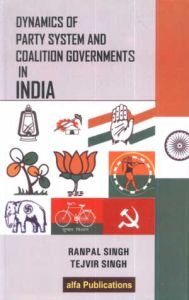
Contents: Foreword. Preface. Introduction. I. Party system in India: 1. Dynamics of party system in India/Ranbir Singh. 2. From one party dominance to multi party system/Jiley Singh. 3. Polity under Strain making political parties accountable/V. Eshwar Anand. II. Coalition governments in India: 4. Coalition government as a global trend: a theoretical analysis/Shweta Dhaliwal. 5. Evolution of coalition Governments in India/Kushal Pal. 6. The typology of coalition governments in India (Narender Singh and Yog Maya. 7. Coalition politics in India-need for anew perspective/Anupama Arya. 8. A paradigm shift in Indian politics from political coalitions to social coalitions/Ashutosh Saxena and Randhir Singh. 9. Economic dimensions of the dynamics of coalition politics in India: institutions, incentives and interactions/Chanchal Kumar Sharma and T.P. Singh. 10. Coalition Governments in India: problems and prospects/B.K. Kaushik. 11. Coalition politics in Nidia: an analysis/Dinesh Arora. 12. Impact of coalition politics on Indian democracy/Raj Pal. 13. Coalition Governments in India: theoretical explanations/Vijay K. Malhotra. III. The case studies of coalition government sin the states: 14. Coalition politics in Punjab: a study of the Akali Dal-BJP coalition/Bhupinder Singh. 15. Coalition governments: the Haryana experience/Saroj Malik. 16. The patterns of coalition governments in Haryana/Tejvir Singh. Index.
The dynamics of party system has led to the conversion of one party dominance system of India into Bi-polar multi-party system due to the regionalisation of Indian politics. This happened because of the combined effect of the processes of modernization, politicization and economic development. It can also be attributed to the impact of the processes of liberalization, privatization and globalization. Lastly, it is the natural result of the continental sized multi regional, multi religious, multi caste, multi cultural, multi lingual and multiethnic character of the policy.
This volume is likely to prove very useful for the teachers, research scholars and the students of political science. It will also be of considerable interest for the political leaders and media persons across ideological lines and leanings.
