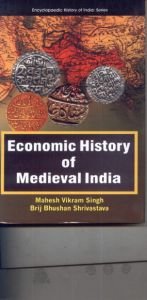
Economic History of Medieval India
Contents: 1. Introduction. 2. Islam and the expansion of trade and economy. 3. The origins of Muslim salve system. 4. Rise of urban economy, trade and commerce. 5. The administrative system of the Sultanate. 6. Trade and commerce under Vijayanagara and its offshoots. 7. Mughal administration. 8. Economic and social developments under the Mughals. 9. Jagirdari system crisis in Mughal period. 10. Economic conditions during Muslim rule. 11. European domination of the Indian Ocean trade. Bibliography. Index.
Though ancient India had a significant urban population, much of India\'s population resided in villages, whose economy was largely isolated and self-sustaining. Agriculture was the predominant occupation of the populace and satisfied a village\'s food requirements besides providing raw materials for hand based industries like textile, food processing and crafts. Besides farmers, other classes of people were barbers, carpenters, doctors (Ayurvedic practitioners), goldsmiths, weavers etc. Along with the family-run business and individually owned business enterprises, ancient India possessed a number of other forms of engaging in business or collective activity, including the gana, pani, puga, vrat, sangha, nigama and sreni. Nigama, pani and sreni refer most often to economic organizations of merchants, craftspeople and artisans, and perhaps even para-military entities. In particular, the sreni was a complex organizational entity that shares many similarities with modern corporations, which were being used in India from around the 8th century BC until around the 10th century AD. During this period, Mughal India was the second largest economy in the world. The gross domestic product of India in the 16th century was estimated at about 24.5% of the world economy, in comparison to Ming China\'s 25% share. The uniqueness of this book hence lies in the author\'s way of reconstructing the period under review by delving deep into the geo-political ground of that time of India. (jacket)
Though ancient India had a significant urban population, much of India\'s population resided in villages, whose economy was largely isolated and self-sustaining. Agriculture was the predominant occupation of the populace and satisfied a village\'s food requirements besides providing raw materials for hand based industries like textile, food processing and crafts. Besides farmers, other classes of people were barbers, carpenters, doctors (Ayurvedic practitioners), goldsmiths, weavers etc. Along with the family-run business and individually owned business enterprises, ancient India possessed a number of other forms of engaging in business or collective activity, including the gana, pani, puga, vrat, sangha, nigama and sreni. Nigama, pani and sreni refer most often to economic organizations of merchants, craftspeople and artisans, and perhaps even para-military entities. In particular, the sreni was a complex organizational entity that shares many similarities with modern corporations, which were being used in India from around the 8th century BC until around the 10th century AD. During this period, Mughal India was the second largest economy in the world. The gross domestic product of India in the 16th century was estimated at about 24.5% of the world economy, in comparison to Ming China\'s 25% share. The uniqueness of this book hence lies in the author\'s way of reconstructing the period under review by delving deep into the geo-political ground of that time of India. (jacket)
