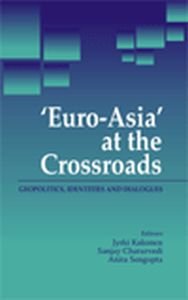
Euro Asia At The Crossroads : Geopolitics Identities And Dialogues
Contents: Introduction. 1. On the metageography of Euro-Asia/Pekka Korhonen. 2. Euro-Asia: cartographic representations and imaginations/Rudolf Wastl. 3. The geopolitics of domination and the clash of imaginations in central Eurasia: continuity and change/Sanjay Chaturvedi. 4. Geostrategic perspectives on Eurasia: towards multilateralism in Central Asia/Anita Sengupta. 5. Turkeys search for identity: a Eurasian and Islamic country/Ayla Gol. 6. September 11 the colour revolutions and the birth of sovereign Democracy/Daragh McDowell. 7. Region as a space of interacting autonomies/Ranabir Samaddar. 8. The paradox of cosmopolitan Eurocentrism in the rise the West/John M. Hobson. 9. The EU in the Eurasian space: an alternative to the USA/Jyrki Kakonen. 10. Conceiving the project of Eurasia through EU India coopertion/Rajen Harshe. Conclusion. Bibliography. Index.
The volume is a critical enquiry into the ways in which space is imagined, represented as well as resisted in geopolitical struggles and in everyday life. It attempts this enquiry through a number of articles that examines these issues in Europe and Asia and touches upon the intricate interplay between the \'geo-economics of hope\' and the \'geopolitics of fear\'. The insertion of a hyphen between \'Euro\' and \'Asia\' underlines the importance of differentiating the concept from the overwhelmingly military strategic connotation of the term \'Eurasia\' or Eurasia as a geo-strategic space. A hyphenated relationship between Europe and Asia underlines the necessity of understanding Euro-Asia as pre-dominantly a socio-economic as well as political-cultural space of continental proportions. This is also a reminder that both \'Asia\' and \'Europe\' are highly heterogeneous places sharing the same continent.
The central argument of the book is that at the dawn of the 21st century the continent of Euro-Asia finds itself at crossroads, a historic juncture from where various alternative futures are possible. Consequently, wide-ranging alternative imaginations of the identities of places and peoples inhabiting and sharing this vast and diverse continent are also possible. Underlying the contention is the assumption that in the absence of such alternative visualizations of Euro-Asian dialogues anchored in the politics of autonomy and aiming at social transformation, gender justice and ecological-human security may not be possible.
