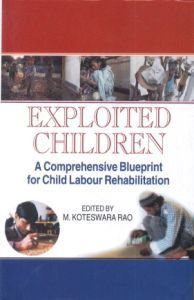
Exploited Children : A Comprehensive Blueprint for Child Labour Rehabilitation
Contents: Introduction. I. Dimensions of Child Labour in India: 1. Trends in child labour in India: a review/M. Koteswara Rao. 2. Child labour in India: an appraisal/Sukhjinder Singh Tiwana. 3. Multi-dimensional approach to child labour in India/Harindra Kishor Mishra. 4. Child labour in India: a multi-dimensional problem/S.K. Patel and R.C. Talati. 5. Child labour in India: extent and causes a case study/Shakuntala Gupta and Sangeeta Nagaich. 6. Assessment of incidence and child development activities in India during fifty years of independence/Mohan Prasad Shrivastava, Virendra Prasad, Kanchan Pd. Shrivastava and Nira Kumari. 7. Trends of urban child labour in India: a review/P. Venu Gopal and K. Sreelakshmamma. 8. Explosive and exploitative scenario of child labour in India/P.C. Tiwari. 9. Child labour: beyond legislation/I. Satya Sundaram. II. Child Labour in Indian Industries: 10. Child labour in Indian states/Vipla Chopra and Harvinder Kaur. 11. Child labour in Bihar/Narendra Prasad. 12. Problem of child labour in India: a case study of Patiala in Punjab/Ajit S. Bhatia and Gurbachan Kaur. 13. Child labour in an urban setting of Kerala/Martin Patrick. 14. Problems of child labour: a case study of Goa/Silvia M. de Mendonca C. Noronha. 15. Child labour in India: a case study of some selected child labour in Dharwad City/L.D. Vaikunthe. 16. Child labour in an informal sector: a case study of Bidar District/Gouradevi Katnalli. 17. Child labour in urban informal sector: a case study of Vijayawada City/M. Koteswara Rao. III. Child Labour in Different Industries: 18. Child labour: diagnosing the problem and rehabilitation of Garage child workers through HRD approach/Kalyani Mohanty. 19. Child labour in Diamond cutting and polishing units in Gujarat: a case study of Bhavnagar City/A.D. Saramma. 20. The working children: a case study of Brick Industry in Nandyal/I. Narendra Kumar and A. Prasad. 21. Child labour: status and gender Bias in Brick Industry/C. Muthuraja. 22. Problems of migrant girl child labourers in Brick and Tiles Industry: a case study of Malur/A.C. Komala. 23. Child labour in Handloom Industry: a case study/N. Narayana. IV. Characteristics of Child Labour in India: 24. Socio-economic dimensions of child labour in India/Raghuraman Narayan, T. Karunakaran and Sriman Narayanan. 25. Socio-economic conditions of child labour in Coimbatore Hotel Industry/V. Ambumani and S. Ganesan. 26. Migrant child labour in Vijayawada City: a Case study/P. Venu Gopal and E. Singa Rao. 27. Migration and child labour: a case study/K. Gangadhara Rao and K. Sreelakshmamma. 28. Landholding, child labour and schooling/R. Nagarajan. V. Curbing Child Labour: 29. The child and the law/M. Koteswara Rao and P. Venu Gopal. 30. Elimination of child labour: a buleprint for action/A.K. Verma. 31. Combating child labour/S. Velayudha Perumal. 32. Child labour in India: problems and methods of abolition/Shyam Nath Nandkeoliyar. Index.
This book consists of thirty-two research papers focusing its attention on the theoretical and empirical findings on various aspects of child labour in developing countries like India. The contents of the book have been divided into five parts. Part I deals with the dimensions of child labour in India. It includes the broad trends of child labour and multi dimensional approaches to study the problem of child labour. The nature, magnitude, working conditions, causes and consequences, exploitation and rights of child labour are discussed at length.
Part II broadly deals with extent and problems of child labour working in various states, districts and cities of India. Part III presents the position of child labour engaged in different industries such as Diamond cutting and polishing, Brick and Tiles industry, garbage units and handloom industry in different parts of the country.
Part IV analyses socio-economic characteristics reveals of child labour such as age and sex, caste, education, levels of living, levels of earning and impact on household incomes. Various aspects of migrant child workers are discusses. Further, this part also explains the nature and extent of labour contribution of children to the rural farm household and determinants of it. This emphasizes the effect of land holding on child labour and schooling of children.
Part V discuss the methods curbing child labour in India. It discusses the number of Acts and legislations, constitutional provisions and legal provisions, which were, enacted to curbe the child labour. The two strategies to eliminate the problem of child labour the pull strategies and push strategies are examined: An attempt is also made in this section to give a blue print of time bond SCOOP Programme for elimination of child labour in India.
The book will be useful to the students and teachers of social sciences like economics, applied economics, urban and labour economic, sociology and social work as also to various agencies, government institutions, NGOs, individual researchers and research institutions connected with the issue of child labour.
