From Stones to Structures Archaeology of Odisha: With Special Reference to Upper Baitarani Valley
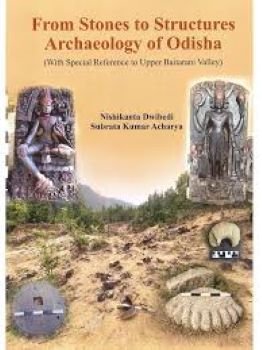
Contents: Preface. 1. Introduction. 2. History of archaeological research in the Upper Baitarani Valley: An appraisal. 3. Recent prehistoric archaeological investigations in the Upper Baitarani Valley. 4. Contouring the material culture: an analysis of lithic assemblages and pottery. 5. Historical archaeology of the Upper Baitarani Valley. 6. Living megalithic tradition among the Munda communities of Upper Baitarani Valley: an ethnoarchaeological investigation. 7. Conclusion. Bibliography. Index.
The river valley cultures have long been the cradle of ancient and powerful civilizations. Like other parts of India, the forest and hilly regions of the Baitarani River Valley in Keonjhar district, Odisha, have provided an ideal setting for human settlement from prehistoric times to the present. The book presents the results of archaeological explorations in the Upper Baitarani River Valley between 2019 and 2023. The fieldwork led to the discovery of sixty-two prehistoric archaeological sites spanning different cultural phases, three early historic sites, and numerous Brahminical and Buddhist architectural and sculptural remains from the early medieval period. A detailed analysis of lithic assemblages, pottery, and architectural and iconographic features of the collections from the fieldwork is presented separately. During the fieldwork, 20 living Megalithic ancestral sites and over 250 living Megalithic-type burials were documented in the Anandapur, Ghatagaon, Patana, and Saharpada blocks of Keonjhar District. The sites provide evidence of living Megalithic practices among the Austro-Asiatic communities of the Upper Baitarani Valley, primarily the Mundas and their sub-communities (Bhumij and Ho), who settled in the hilly regions of the Upper Baitarani River Valley in northern Odisha. The book is a comprehensive work on reconstructing the archaeological potential of the Upper Baitarani Valley in northern Odisha. The archaeological remains clearly indicate a continuous cultural sequence from the Palaeolithic to the Medieval period, with sites featuring Middle Palaeolithic, Upper Palaeolithic, Microlithic and Neolithic stone tools, as well as numerous Brahminical, Buddhist and Jaina art and architectural remains.
