Global Economic Crisis and Impact on Indian Economy
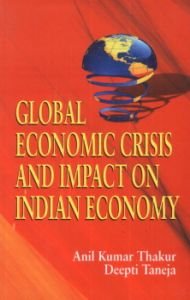
Contents: Preface. Introduction. 1. Global economic crisis and Indian economy/Manoj Panda. 2. Global economic crisis: the ideas of Keynes reinstated/Archna Sinh. 3. Global financial crisis and the Indian economy/R. Arunachalam. 4. India\'s revival agenda and global economic crisis/Amalesh Banerjee. 5. Global financial crisis and its impact on the Indian economy/S.B. Mishra. 6. Gobalization, global meltdown and the Indian economy/Ratan Kumar Ghosal and Saikat Bhattacharyya. 7. Global economic crisis: a macroeconomic explanation of structuralist theory and verification of Decoupling hypothesis on the Indian economy/Dhiraj Kumar Bandyopadhyay. 8. Financial crisis: Indian economic growth and external sector/D.K. Nauriyal and Binal Sahoo. 9. A Study of interrelation between London and Indian stock market and impact of the global slowdown on the Indian economy/Shri Prakash and Ritisnigdha Panigrahi. 10. Global financial meltdown and its impact on the Indian economy/Abhishek Kumar. 11. Contagion effect of global financial crisis on stock market in India/Mahendra Ranawat and Veenu Yadav. 12. Impact of global financial crisis on Indian economy/Rajiv Kumar Bhatt. 13. Global financial crisis and its impact: need for a comprehensive and swift action/K.M. Naidu, L.K. Mohan Rao, P.V. Manjushree and K. Mahesh Naidu. 14. Global economic crisis and the Indian economy/Purna Chandra Mishra. 15. Global financial crisis and its impact on the Indian economy/Swami Prakash Srivastava. 16. Global economic crisis and the Indian economy/Chandra Kant Singh and Rajesh Kumar. 17. Global financial crisis and its impact on the Nepalese economy/R.K. Shah. Index.
The years after 2007 saw the onset of recessionary and depression tendencies the world over. The new era of depression economics had begun and the financial crisis had engulfed major economies of the world. The 1999 repeal of the Glass-Steagall act had set the ground for the sub prime crisis, which soon became a full blown financial crisis with financial giants like Lehman Brothers, AIG, Toyota, Freddie Mac and Fannie May, etc. becoming prey to this crisis.
Economies like India were initially thought to be decoupled from this crisis that originated in the west and it was believed that the contagion effect would not have such a wide spread. However, with time, the crisis became became more pronounced than it was thought of earlier, because of the globalised world that we live in, with economic integration of the economies the world over, being the order of the day. The Indian economy felt the impacts in terms of declining growth rates, foreign capital flows, foreign trade, dwindling real economy and the fiscal sector and a major downturn in the stock market.
The events of the past, especially the last two decades, wherein Japan spent most of the 1990s in an economic trap, Asia went from boom to calamity virtually overnight and more recently the modern world, with the presence of sophisticated bankers and government officials, not to mention. The International Monetary Fund and The World Bank, did plunge into a depression like situation, make it amply clear that no sensible person would do the mistake of thinking that the age of economic anxiety is past. In times to come, we need to clear the obsolete doctrines that clutter our minds and have a clear understanding of the financial issues and policy designs, to steer clear of such crises and have strong and consistent global economic fundamentals and the associated growth rates. (jacket)
The years after 2007 saw the onset of recessionary and depression tendencies the world over. The new era of depression economics had begun and the financial crisis had engulfed major economies of the world. The 1999 repeal of the Glass-Steagall act had set the ground for the sub prime crisis, which soon became a full blown financial crisis with financial giants like Lehman Brothers, AIG, Toyota, Freddie Mac and Fannie May, etc. becoming prey to this crisis.
Economies like India were initially thought to be decoupled from this crisis that originated in the west and it was believed that the contagion effect would not have such a wide spread. However, with time, the crisis became became more pronounced than it was thought of earlier, because of the globalised world that we live in, with economic integration of the economies the world over, being the order of the day. The Indian economy felt the impacts in terms of declining growth rates, foreign capital flows, foreign trade, dwindling real economy and the fiscal sector and a major downturn in the stock market.
The events of the past, especially the last two decades, wherein Japan spent most of the 1990s in an economic trap, Asia went from boom to calamity virtually overnight and more recently the modern world, with the presence of sophisticated bankers and government officials, not to mention. The International Monetary Fund and The World Bank, did plunge into a depression like situation, make it amply clear that no sensible person would do the mistake of thinking that the age of economic anxiety is past. In times to come, we need to clear the obsolete doctrines that clutter our minds and have a clear understanding of the financial issues and policy designs, to steer clear of such crises and have strong and consistent global economic fundamentals and the associated growth rates. (jacket)
