Global Meltdown and Indian Economy
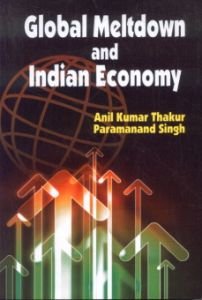
Contents: Preface. Introduction. I. World economic crisis: profiling the issues--concept, content and theoretical explanation: 1. The global economic crisis: the genesis and the wayout of the conundrum: an analysis/Paramanand Singh and Shashi Bhushan Prasad Singh. 2. Global economic and financial crisis: causes, consequences, channels of contagion and India\'s prospects/Duresh Kumar Singh and Prahlad Kumar. 3. Financial crisis: is it time to think beyond Keynes?/G.P. Tripathi and S.K. Choubey. 4. Decoupling theory--an myth or a reality/Amrita Nandi. II. Global meltdown: policy decisions and regulatory measures and its various facets: 5. Home-owning democracy to housing bubble: recent financial and economic crisis in USA/A. Venkateswarlu. 6. Global meltdown and India\'s response/Mithilesh Kumar Sinha and Ashwani Kumar Srivastaba. 7. Recent global economic crisis: outsourcing and India/Abhay Narayan Rai, Rakesh Kumar Singh and Manmohan Krishna. 8. Global financial crisis: response to RBI as a national regulator/Bhavik M. Panchasara and Heena S. Bharadiya. III. Global recession--regional and sectoral variations and vulnerable states: 9. The impact of the current global financial crisis on South Asian countries/Ch. Paramaiah. 10. Impact of global meltdown on India\'s real estate/Tapan Kumar Shandilya and Suraj Kumar. 11. Impact of the global economic crisis on Indian real estate sector/Harvinder Kaur. 12. Triggers of the global financial crisis and its impact on the Indian service sector/Pradhyumna Tripathy, Arindam Das and Mohua Mazumder. IV. Global financial crisis and Indian economy: 13. Global economic crisis and India/R.S. Bawa and Manjit Singh. 14. Global financial turmoil: impact on the Indian economy/Vipla Chopra and Bharti Kapur. 15. Impact of financial crisis on the Indian economy/S.K. Dhage and B.G. Lobo. 16. Impact of the global financial crisis on the Indian economy/M. Sundara Rao and P. Ramu. 17. Global economic meltdown and its impact on the Indian economy/Asim K. Karmakar. 18. Implications of global recession for the Indian economy/P.S. Kamble. 19. Impact of global financial crisis on India: an analysis/Channabasavan Goudap and K.A. Rasure. 20. The global financial crisis and the Indian economy/Mandakini Mahore and Samit Mahore. 21. The sub-prime crisis and its impact on the Indian economy/R.Y. Mahore. 22. The global financial integration, innovations, damages and the Indian economy: a perspective/Mohammad Asif and Hena Nisar. Index.
The present edited volume is the outcome of Indian Economic Association 92nd Annual conference at KIIT University, Bhubaneswar, where one of the technical session was on global meltdown and its impact on Indian economy, organized jointly by IEA and Kalinga Institute of Industrial Technology on 27-29 December, 2009.
There were all together 66 papers in full and equal number in abstracts presented. Out of this twenty two relevant and best papers were selected which analyse the core issue inherent in the global economic crisis. Capitalism is basically a market based economy striving for profit. It has a great intensity to save and weak potential for investment. This endemic nature of capitalism leads to long run unemployment and a process to recessionary transition leading ultimately to stagnation. The dynamics of U.S. capitalism, its corporate structure and cunning play of money power via credit leads to a situation where credit is given to the defaulters. To credit where credit is due is a wrong dictum and its this endemic capitalist behaviour led by American credit and investment giants Lehman Brothers Holding Inc. created the crisis situation. The genesis of the crisis can be traced back to reckless financial profligacy of U.S. banking system that disbursed loans to sub prime brokers who had new traced record of redemption of loan from their income, sub prime lending was advanced with speculative bubbles or with the exploration that real estate would enable the debtors even with dodgy credit background to reimburse the loan as domestic prices escalated at an unprecedented rate. The global financial crisis germinating from this U.S. rot not only shattered .S. economy but the global economy was entrapped in the Cobweb of depression.
Altogether twenty two articles covered in this volume explain the world financial crisis in its various dimensions discussing the various issues--the genesis, theoretical explanation, policy regimes and regulations, regional and sectoral ramification and finally its multidimensional impact on Indian economy. (jacket)
The present edited volume is the outcome of Indian Economic Association 92nd Annual conference at KIIT University, Bhubaneswar, where one of the technical session was on global meltdown and its impact on Indian economy, organized jointly by IEA and Kalinga Institute of Industrial Technology on 27-29 December, 2009.
There were all together 66 papers in full and equal number in abstracts presented. Out of this twenty two relevant and best papers were selected which analyse the core issue inherent in the global economic crisis. Capitalism is basically a market based economy striving for profit. It has a great intensity to save and weak potential for investment. This endemic nature of capitalism leads to long run unemployment and a process to recessionary transition leading ultimately to stagnation. The dynamics of U.S. capitalism, its corporate structure and cunning play of money power via credit leads to a situation where credit is given to the defaulters. To credit where credit is due is a wrong dictum and its this endemic capitalist behaviour led by American credit and investment giants Lehman Brothers Holding Inc. created the crisis situation. The genesis of the crisis can be traced back to reckless financial profligacy of U.S. banking system that disbursed loans to sub prime brokers who had new traced record of redemption of loan from their income, sub prime lending was advanced with speculative bubbles or with the exploration that real estate would enable the debtors even with dodgy credit background to reimburse the loan as domestic prices escalated at an unprecedented rate. The global financial crisis germinating from this U.S. rot not only shattered .S. economy but the global economy was entrapped in the Cobweb of depression.
Altogether twenty two articles covered in this volume explain the world financial crisis in its various dimensions discussing the various issues--the genesis, theoretical explanation, policy regimes and regulations, regional and sectoral ramification and finally its multidimensional impact on Indian economy. (jacket)
