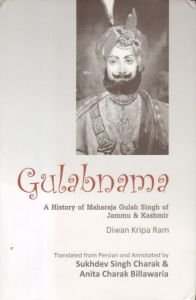
Gulabnama : A History of Maharaja Gulab Singh of Jammu and Kashmir
Contents: Preface. Foreword. Introduction. 1. Prologue. 2. Statement of the late highness angelic pedigree. 3. Mediaeval genealogy. 4. Modern ancestors. 5. British and early life of Maharaja Gulab Singh. 6. An account of Wazir Fateh Khan’s conquest of Kashmir country. 7. An account of surprising adventures of the Tiger of battle field and the murder of Trehdu the worthless. 8. Te ride of the King of Lahore on Kashmir for the first time. 9. Obtaining the jagir of Beol, etc. 10. The conquest of Garh Dhamala Fort. 11. Acquiring Ramgarh Jagir. 12. The Multan Campaign. 13. Conquest of Riasi. 14. Chastisement of the wicked rebels. 15. Raja Dhian Singh get charge of the Deodhi. 16. An account of the conquest of Kashmir. 17. Assignment of Jammu country to his lordship on lease. 18. Conquest of Kishtwar. 19. Conquest of Mankera and derah Gazi Khan. 20. Battle with Yusufzai for the first time….
The Dogras of Jammu are a stout people with a tradition of culture and chivalry going back to the hoary past. Their contribution to the cultural heritage of India in the shape of painting of Jammu and Basohli schools and their various offshoots, is priceless. Precious still are the annals of their chivalrous conquests of the Himalayan and trans-Himalayan territories which pushed India’s frontiers to verge on central Asia, an achievement of national pride which places Maharaja Gulab Singh in the frontline of the builders of India’s destiny.
Gulabnama is the history of Dogras in general since ancient ages, and a comprehensive biography of Maharaja Gulab Singh in particular, for which it is a reliable and first hand source. Its translation into English and historical annotation by a renowned scholar and historian of the region, has rendered the book a more valuable study on the history of the Dogras.
Gulabnama written in Persian by Diwan Kirpa Ram, the Maharajas private secretary and the son of Diwan Jwala Sahai, the Maharaja’s Prime Minister…This work, though written in the flowery style of the Persian Panegyrists, is none the less a remarkable Persian document as the Diwan published in it many original documents which are not now available anywhere else. Its facts and chronology are beyond dispute, the Diwan was also fully conversant with the political conditions of the Punjab at the time, and his descriptions of events are vivid and informed by direct knowledge of men and things. (jacket)
