India\'s Comprehensive National Power : Synergy Through Joint Decision Making--A Study Report
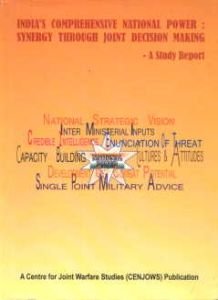
"The expanded base of national power today, necessitates a review of our capability to integrate these facets into a comprehensive whole. Even as the sphere of national influence has expanded so is the challenge to our security and the complexity of governance. With over 40 Ministries and departments of the Central Government a coordinating inter agency mechanism has become a paramount need of the hour to sustain our national interest across the globe. While the present systems have served their purpose so far, there is a need to review these from the perspective of functioning in the information age, where increasingly, governance is being carried out at the, "speed of thought". Moreover for a developing country as India, security and development are two sides of the same coin. This is amply evident with the many challenges facing us in diverse spheres from Naxalism to Terrorism. A joint national security decision making which could contribute to comprehensive national power through seamless inter agency coordination between all agencies involved in national defence is thus the need of the hour. This important study addresses this challenge very lucidly and comprehensively.
In globalized world ability for bilateral and multilateral engagement in diverse spheres be it trade, culture, tourism or defence is being recognised as the hallmark of a nation\'s political as well as economic power. This in turn can be used subtly by an adversary to gain not just economic advantage but virtual dominance over functioning of markets, polity and even society. While the process of integration with global political, social and economic landscape is irreversible, there is a need to understand these diverse challenges to meet them proactively and convert them into opportunities.
To attain the same the process for national security decision making has to be far more rigorous than hithertofore. There is a need for expanding the number of agencies involved so that emerging challenges in diverse spheres can be appreciated well in time and proactive actions taken. Use of existing information technology tools can be made to for dynamic, transparent and speedy decision making at the national level. The aim is not to breach the existing system but to create capacity for cross cultural functioning so as to provide greater impetus to security decision making focusing on our national interest at all times. Thus, a pragmatic approach for easy implementation and all round acceptability has to be adopted. The Study Group has comprehensively surveyed these issues linking these to our national interest and provided a paradigm for transformation which is evolutionary and sustainable while at the same time contributing to the comprehensive national power." (jacket)
