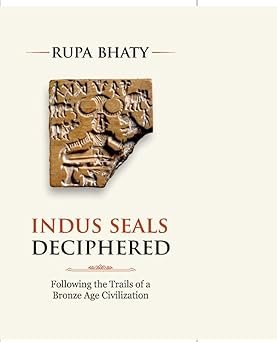
Indus Seals Deciphered: Following the Trails of a Bronze Age Civilization
Contents: Preface. 1. Deciphering the Indus Script. 2. The place names in IVC seals. 3. Important people in IVC seals. 4. The trading items from Meluhha Port. 5. Tracing Magan and its people via Indus seals. 6. Reassessing the location of Meluhha in IVC. 7. Traces of Indian names and deities in Asia Minor post IVC. 8. Francolin-line bird in IVC seals. 9. Wood in IVC seals and Sumerian texts. 10. Buzkashi and goat economy in Prism seals. 11. The term Mana and Indus weight system. 12. Proto-Bill of lading system in the Indus Civilization.
This book advances a concrete and testable proposal about the Indus script: that a substantial portion of the seal corpus records the names of places, persons, commodities, and institutions that operated within a Harappan-Mesopotamian maritime and overland trading world, and that a subset of those names can be systematically aligned with Sumerian and Akkadian toponyms and royal onomastics. The argument rests on three strands of prior scholarship: (i) quantitative work suggesting that the Indus inscriptions have the statistical structure of human language (Rao); (ii) sign-by-sign proposals for phonetic values and allographic groupings (Sullivan; Yajnadevam); and (iii) the growing archaeological map of Indus artefacts and scaling technology in Bahrain, Mesopotamia, the Gulf, Anatolia, and beyond. Against this backdrop, the central question is straightforward: if seals were embedded in such a wide trading network, why do their short inscriptions seem so mute about the ports, rulers, goods, and measures that the archaeology so clearly attests? The chapters that follow address this question by applying a transparent and falsifiable reading method to a broad range of seals, including those that sit uneasily within purely Vedic or purely Dravidian frameworks.
