Introduction to Economics
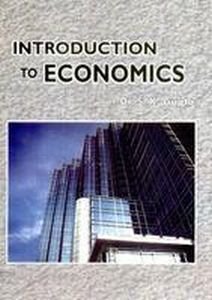
Contents: Preface. 1. Introduction. 2. Economics as Value-free. 3. Macroeconomics and Macromorality. 4. Income Consumption and Price Consumption Relationships. 5. Long-run Economics. 6. The Principles of Economics. 7. The critique of Orthodox economics. 8. Economics and institutions. 9. Polarities in contemporary economics. 10. Naturalism in economics. 11. The nature of transition cost. Bibliography. Index.
Economics is the social science studying the production, distribution and consumption of goods and services. It is a complex social science that spans from mathematics to psychology .At its most basic, however, economics, considers how a society provides for its needs. Its most basic need is survival which requires food clothing and shelter. Once those are covered it can then look at more sophisticated commodities such as services personal transport entertainment the list goes on.
It developed in the 18th century based on the idea that economics can be analysed mathematically and scientifically. Other schools of thought have included classical and modern political economy Marxian economics institutional economics and Keynesian economics. These all have different emphases on certain aspects of economics. These all have different emphases on certain aspects of economies.
Economics is the study of how individual and societies choose to use the scarce resources that nature and previous generations have passed to them. In a large measure it is the behavioral science studying individual choices and more broadly societal choices added up from them.
Economics aims to explain how economics work and how economics agents interact. Economics analysis is applied throughout society, in business finance and government but also in crime education, the family health law politics religion social institutions war and science. The expanding domain of economics in the social sciences has been described as economic imperialism. Common distinctions are drawn between various dimensions of economics. (jacket)
