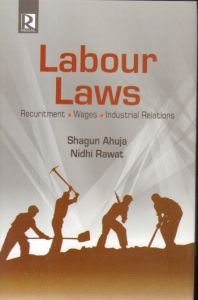
Labour Laws : Recruitment, Wages, Industrial Relations
Contents: Preface. I. Introduction and recruitment laws: 1. Introduction to labour laws. 2. Industrial relations and labour laws. 3. Labour laws Act, 1988: (Exemption from furnishing return and maintaining registers by certain establishments). 4. The apprentices Act, 1961. 5. The employment exchanges (Act and Rules). 6. Industrial employment (Standing orders) Act, 1946. 7. Child labour (Prohibition and regulation) Act, 1986. II. Law relating to wages: 8. Payment of wages Act, 1936. 9. Payment of gratuity Act, 1972. 10. Payment of bonus Act, 1965. 11. The minimum wages Act, 1948. 12. Employees provident Fund and Miscellaneous provisions Act, 1952. 13. Employees state insurance Act, 1948. 14. Equal remuneration Act, 1976. III. Law relating to industrial relations: 15. Trade Union Act, 1926. 16. The factories Act, 1948. 17. Industrial dispute Act, 1947. 18. Workmen compensation, Act. 19. Contract labor (regulation and abolition) act, 1970. 20. The maternity benefit Act, 1961. Bibliography. Index.
Labour law was introduced for fulfilling the demands of workers for better working conditions, and the simultaneous demands of employers for restricting the powers of workers so as to keep the labour costs low. The costs of employers increase when workers organize for winning higher wages or due to the costly requirements imposed by the law like provisions of health and safety or conditions of equal opportunities. Some employers may oppose the workers organizations such as trade unions which transcend purely industrial disputes and gain political power. The position of labour law at present is the result of a struggle between different interests of society.
The present book provides an insight to the theoretical and practical implications of the various labour legislations. The book highlights the provisions of different labour legislations and provides a framework within which employers, workers, and their representatives can interact in relation to the work related issues, it also serves as an important vehicle for the achievement of harmonious industrial relations based on the workplace democracy. The present book brings our a clear and constant reminder and guarantee of fundamental principles and right to work, which have received broad social acceptance and establishes the processes through which these principles and rights can be implemented and enforced in an efficient manner. In the nutshell an attempt has been made through this book to provide an insight into the various labour legislations in India. (jacket)
