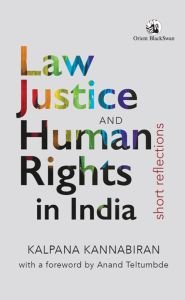
Law, Justice and Human Rights in India: Short Reflections
Contents: Introduction. Part A: Understanding Discrimination. I. The Adivasi Experience. 1. Adivasis and Gujarat 2002. 2. The Burden of Criminal Neglect. 3. Constitutional Conversations on Adivasi Rights. 4. Without Land or Recourse. II. Blocked by Caste. 5. Caste, the Academy and Dalit Women. 6. Reservation and the Creamy Layer. 7. Chunduru: On the Road to Justice. 8. Roadmap for Reservation in Higher Education. 9. Atrocities That No Longer Shock. 10. Scope of Constitutional Morality. 11. The Annihilation by Caste. 12. Post-truths about Rohith Vemula. III. Disability Rights. 13. Creating Enabling Environments. 14. The Rights of Prisoners with Disabilities. 15. Between the Divine and the Diabolical: Disability Rights over the Edge. 16. Right to Privacy as Right to Life. IV. Minority Rights. 17. An Apology to Mohammed Akhlaq. 18. Kashmir and Una Define a New Practice of Politics. 19. Babri Masjid Revisited. 20. We Shall Not Be Silenced, nor Shall We Ever Forget. V. Queer Rights. 21. From ‘Perversion’ to Right to Life with Dignity. 22. It’s Time to Scrap the Eunuchs Act. VI. Women’s Rights. 23. Rethinking the Law on Sexual Assault. 24. Girl Punk, Interrupted. 25. A Moment of Triumph for Women. 26. Lessons from Badaun and Beyond. 27. Article 17 is at the Heart of the Matter. 28. Graded Patriarchies and Graded Inequality: Sabarimala. 29. Judicial Opacity on Women’s Entry in Sabarimala. Part B: Civil Liberties, Human Rights and Law. VII. Civil Liberties. 30. On Human Rights and Radical Evil. 31. The Abolition of the Death Penalty. 32. Something is Rotten in the States of … 33. And We Must Say It Again … Again Yet Again. 34. Democratic Futures in Peril: An Assault on the Right to Privacy. 35. Constitutional Justice is Non-negotiable. VIII. Free Speech. 36. Free Speech is the Cornerstone of Constitution. 37. ‘Hard Words Break No Bones’: Sedition, Free Speech, Academic Freedoms and Sovereignty in India. 38. Mourning the Loss of Gauri Lankesh. 39. Taking Aim at the Messenger. 40. No Rollback on the Right to Dissent. 41. Kancha Ilaiah: For Lives Lived in Labour. 42. ‘They Cannot Stop Me from Teaching Marx and Ambedkar’: A Conversation with K. Satyanarayana. 43. Hate Speech and the Barbarity of ‘False Equivalence’. IX. Professions and Civil Rights. 44. Of Lawyers and the Law. 45. Lawyer, Judge and Aam Aadmi. 46. When Professional Associations Start Promoting Narrow Sectarian Agendas. X. Judges are Equal Citizens. 47. Parables of Justice and Women Therein. 48. Privacy, Sequestered Courts and the Place of Dissent. 49. The Court is not above the Constitution. 50. Redeeming the Constitution. 51. Juridical Viralities, Courts and the Question of Justice. XI. ‘Freedom to Be’ in Universities. 52. Education, Campuses and Violence. 53. Disrupting Caste in Class. 54. A Call to Resurrect the Constitution, or What is a University? 55. Urgent Notes from a University in Crisis. 56. The University is not a Feudal Village. 57. A Year after Rohith Vemula’s Death … 58. ‘I Don’t See What is Happening within Universities as Separate from What is Happening in the Political Arena’. XII. Human Rights Cultures. 59. Development, Justice and the Constitution. 60. Regulating Cultures through Food Policing. 61. Paresh Rawal Must Be Asked to Forfeit His Seat. XIII. Futures of Citizenship. 62. Of Law, Resurrection and a Future. 63. Constitution, Hostile Environments and ‘Atrocious’ Interpretation: A Sign of Our Times. 64. Through the Clouds of Protest, Sightings of Hope. 65. Retrieving the Idea of Citizenship. 66. Safoora Zargar and the Search for India’s Soul. 67. Governance by Annihilation and by Hate.
Law, Justice and Human Rights in India is a collection of short essays on a range of contemporary issues—prisoners’ rights, campus violence, women’s rights, state impunity, judicial accountability, citizen engagement in law-making, and questions of discrimination against Dalits, Adivasis, persons with disabilities, and sexual and religious minorities.
Framed by the Constitution of India, the chapters provide a sense of the times we are living through, with each essay addressing an urgent debate that has arisen at a particular moment in India’s contemporary history. Kalpana Kannabiran brings her formal training in law, sociology and gender studies, and her work as a feminist socio-legal counsellor with a women’s collective, into her essays, allowing them to open up alternative spaces for dialogue and public discourse on dissent. Reflecting upon issues of social justice and human rights, she offers insights into the Constitution and law, moving these out of the sacred, unreachable precincts of constitutional courts and into the realities of everyday life.
This volume presents an account of the making and unmaking of laws through resistance struggles and movements, encouraging readers to engage with the language, protocols and practices of legislations.
The continuing relevance of the concerns raised in this collection and its level critique of power and dominance will interest anyone who wishes to trace the development of human rights debates in India over the past two decades.
