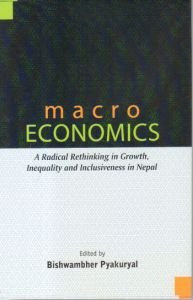
Macro Economics: A Radical Rethinking in Growth, Inequality and Inclusiveness in Nepal
Contents: Macroeconomy: Growth, inequality and inclusiveness/Bishwambher Pyakuryal. 2. Macroeconomic challenges: achieving sustained and broad-based inclusive growth/Prithvi Raj Ligal. 3. Fiscal reforms for sustainable growth/Madan Kumar Dahal. 4. Investment for employment and growth/Shankar Sharma. 5. Enhancing external sector for sustained high growth/Posh Raj Pandey. 6. Partial and total factor productivity in Nepal: a review and policy implications/Binod K. Karmacharya. 7. Improving social sector for sustaining broad based inclusive growth/Devendra Pd. Shrestha. 8. Energy security and oil sector reform/Purushottam Ojha. Index.
The present book aims, at complementing the Government of Nepal's initiative to bring about second generation economic reforms by addressing the binding constraints to development and its consequences to maintain high, broad-based sustainable and inclusive growth.
The realization today is the fact that in the developed countries, the era of high economic expansion is over. Redesigning the industrialization and development models as new drivers to growth is required. To do this, new knowledge frontiers are being discussed and the importance of exploring extensively the new drivers is also realized in developing countries as well.
At a time when growth was possible and poverty reduction was satisfactory, available data in Nepal's Living Standard Surveys shows there was widening disparity in income and non-income outcomes with increasing inequality between the rich and poor and the disadvantaged sections of the people. Unless existing models of development is restructured the question of accelerated, broad-based, sustainable and inclusive growth will remain unanswered. This would mean the threat to government’s so-called second generation reform.
With this in mind, the book explores new areas of threats and opportunities and develops roadmap for development by especially focusing on macroeconomic challenges, fiscal reforms, investment and employment, external sector regime partial and total factor productivity, social sector and energy security. The book also examines how well-developed economic instruments can correct macroeconomic anomalies and keep the development policies on track. (jacket)
