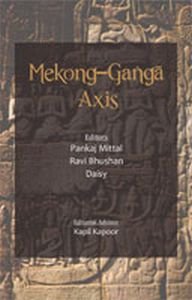
Mekong-Ganga Axis
Contents: Foreword/Asha Kadyan. Preface/Kapil Kapoor. 1. The role of classical Indian theatre in spreading the cultural influence of India to South-East Asia/M. Krzysztof Byrski. 2. Concepts for the revival of traditional links between India and South-East-East Asia for global leadership/Bal Ram Singh. 3. Cultural heritage of Champa Kingdom in Central Vietnam: some evidences of the interaction of the trade and the religion between India and Vietnam in the past/Do Thu Ha. 4. Colonial, modern, or traditional? how to read the Indo-Saracenic architecture of South and South-East Asia/Hawon Ku. 5. Cultural relationship between India and South-East Asia/Tran Phuoc Phuong Thao. 6. Indian trade textiles for Thai market/Prapassorn Posrithong. 7. Hindu–Buddhist syncretism in the Trans-Himalaya and South-East Asia: an attempt at a comparative study of religious literature of Tibet and Bali/Alexander Zorin. 8. Beyond the horizon of culture-spectrum/Kakali Ghoshal. 9. Far from the Mother’s womb/Madhu Kapoor. 10. Thailand and Karnataka/G Kavyashree and P. Nagabhushanagoud. 11. Global ancient India and Suvarnabhumi (South-East Asia): a historical perspective/Shiva G. Bajpai. 12. The interconnection between India and South-East Asia especially Indonesia in art, culture and architecture/Komang Santhi Arsa. 13. Interculturality in South Asia: with special reference to dissemination of Ramakatha/Avadhesh Kumar Singh. 14. Syncretism of the cultures of India with the cultures of South and South-East Asia/S. Ram Mohan. 15. Understanding South Asia-South-East Asia cultural contacts: an alternative perspective/T.S. Satyanath. 16. Religious art in Cambodia: Shaivism, Vaishnavism and Buddhism/Rajnish Kumar Mishra. 17. Buddhist engagement in South-East Asia: a case study of Vietnam/Anita Sharma. 18. Shaivism in ancient Cambodia as revealed from Sdok Kak Thom inscription/Bachchan Kumar. 19. Ramman Pattar performance in the Central Himalaya and its parallels in the Balanese and Javanese Theatre/D.R. Purohit. 20. Reflection of Indian culture in the Kambuja empire of South-East Asia/Swati Raikhy. 21. Cultural relationship between India and Thailand/Shyam Sunder Sharma. 22. Reinventing the connectedness: implications for India in Mainland South-East Asia/Sarita Dash. 23. Dakshini-Purvi Asia ke Deshon mein Ram ka Prabhava/Pawan Kumar. 24. Bharatiya Sanskriti Tatha Ramayana ka Thailand par Prabhava/Manju Bala. Contributors. Index.
India has a fascinating history of cultural relationship with South-East Asia, spanning across more than the last two millennia, mainly with the spread of Buddhism and Hinduism, deeply impacting the cultural, religious and social lives of people in countries such as Cambodia, Indonesia, Laos, South Korea, Sri Lanka, Thailand and Vietnam. The Hindu-Buddhist monuments in South-East Asia stand testimony of this peaceful and mutually beneficial interaction. The contents of this book - Mekong-Ganga Axis - centre around India's association with most of the countries of the region, especially those on either side of the Mekong River.
Most of the South-East Asian countries were influenced by more than two foreign cultures, though they have an indigenous culture. The Chinese and Indian cultures had impacted them the most, in addition to the European influence. However, only India’s impact was peaceful and, to a great extent, non-political. This paved the way for many developments in architecture, religious engagements, interculturality, syncretism of cultures, inter-literariness, composite literary cultures, religious arts, trade relations and so on.
This book thus critically engages one to all these topics and more, and recalls India's glorious relationship of the forgone era with these countries, showcasing somewhat a similar kind of cultural/religious affinity from South China to India. And two great rivers, Mekong and Ganga, are witness to it. It also reinstates the criticality of India to be engaged with these countries at present because of the compulsions of a globalized world.
