Mineral Atlas of India
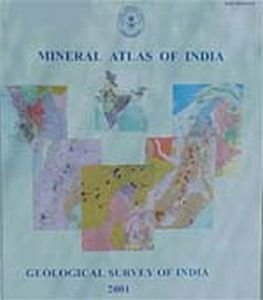
"From the introduction: Publication of a mineral Atlas of India depicting mineral resources and geological set up has been a long felt need. In the present edition of the Atlas, on scale 1:2 million, attempts have been made to project not only the distribution of the mineral deposits, but also their potentialities. Compilation of this Atlas is aimed to cater to the needs of the mineral industry and the geoscience community in general. In view of the recent liberalization of the mineral policy, it is expected that this publication will be of help to the perspective investors to get an overview of the country’s mineral potential.
"The Atlas has been prepared on the format of the mineral distribution Atlas of ESCAP region and marginally modified to suit Indian standards and needs. The map data are presented in an Atlas form with each map in 60 X 40 format for better presentation and readability. A total of 24 maps cover the entire country. Each map consists of two to four sheets depending upon the number of mineral commodity groups present in that area. In total there are 77 map sheets including the index map.
"A generalized geological base, prepared in accordance with the geological map of India on scale 1:2 million (Seventh edition, published by GSI in 1998), is presented. However, Archaean and Proterozoic rocks are shown in more details, as most of the metalliferous deposits are associated with this era. Phanerozoic rocks, on the other hand, have been broadly subdivided into Palaeozoic, Mesozoic and Cainzoic. Chronostratigraphy has been shown in standard alphanumerics and also differentiated by colours.
"The mineral data are collected and collated from various publications and unpublished reports and maps. The database of different mineral commodities ranges from 1980 to 1994. The mineral commodities are subdivided into Metallic, Non-metallic minerals and Mineral fuel. Oil and natural gas, however, have not been included.
"In this Atlas the minerals are grouped into nine categories mainly on end use basis namely (1) Iron and Ferro-alloy metal, (2) Base metal, (3) Light metal, (4) Precious metal, (5) Chemical and fertiliser mineral, (6) Ceramic and refactory mineral, (7) Precious stone, (8) Other industrial mineral, (9) Mineral fuel (Coal and lignite). All the mineral depsits are numbered, whereas the occurrences are not, except for the strategic minerals. A list showing the deposit name, location, lithology and age of host rocks etc., has been appended to the Atlas (Part III)".
