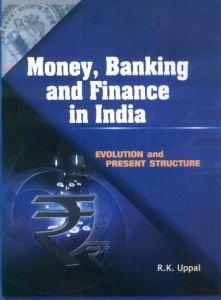
Money Banking and Finance in India : Evolution and Present Structure
Contents: Preface. I: Money, Reserve Bank of India and Monetary Policy. 1. Functions and management of money. 2. Reserve Bank of India: History and functions. 3. Monetary Policy developments in India. II: Banking Institutions in India. 4. Commercial Banks. 5. Regional Rural Banks. 6. Urban Co-Operative Banks. 7. Rural Credit Co-Operatives. 8. Development Banks. 9. Non-Banking financial intermediaries. 10. Internet Banking in India. III: Financial markets and instruments. 11. Financial sector reforms in India. 12. Financial Markets in India. 13. Money Market. 14. Government securities market. 15. Capital Market. 16. Corporate Debt Market. 17. Credit Market. 18. Foreign exchange market. 19. Payment Systems, Clearing and settlement. 20. Integration of financial markets. 21. Financial derivatives: An Introduction. 22. Forwards, Futures and Options. 23. Derivative instruments in India. Bibliography. Index.
Money banking and finance are at the heart of an economic system. A modern economy, characterized by acute specialization and exchange, is unthinkable without money, banking institutions, financial markets and financial instruments. The present work provides a fairly exhaustive account of the evolution and present structure of monetarym, banking and financial system of India with focus on post 1991 period. The book is organized into three parts.
Part I of the book deals with forms and functions money (including e-money), role of the Reserve Bank of India (RBI) in monetary and credit management and the evolution of monetary policy in India since independence in 1947, focusing on post liberasation (1991 onward) period.
Part II describes and critically examines the functioning of various banking institutions in India, covering commercial banks, regional rural banks urban cooperative banks rural cooperative credit institutions, and development banks. Apart from these regular banking institutions a number of other financial organizations play a significant role in the Indian financial system. Among them, the following three are also covered in this part of the book: non-banking financial companies, mutual funds and insurance organizations.
Part III begins with the role of financial system in economic development. It traces the evolution of India’s financial system since independence and explains its present structure. It focuses on the reform measures introduced in money market, government securities market, capital market, corporate debt market, credit market, and foreign exchange market. It also dwells on payment clearing and settlement systems integration of financial markets and emergence of financial derivatives in India.
