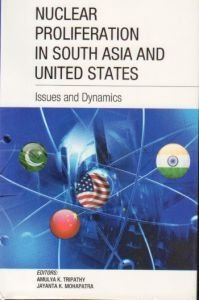
Nuclear Proliferation in South Asia and United States : Issues and Dynamics
Contents: 1. Nuclear race in South Asia: a study on role of United States/Amulya K. Tripathy. 2. US-South Asia nuclear diplomacy/J.K. Baral, A.K. Tripathy and S.B. Baral. 3. US non proliferation policy towards South Asia: issues and recent changes/P.M. Kamath. 4. US Nuclear policy towards South Asia and its implications for China/Jayanta K. Mohapatra. 5. America and Nuclear non-proliferation in South Asia, problems and challenges/Narottam Gaan. 6. Indo-US deal Nuclear or unclear implications for Indian Diplomacy/Pragyanshu Amaoni and Vidya Prakash Maurya. 7. Indo-US 123 agreement issues impacts and intentions/Srimayee Dam. 8. US India civil nuclear cooperation agreement: interests dynamics and implications/Sivani Baral. 9. Making sense of nuclear non proliferation regime/Tej Pratap Singh. 10. FMCT negotiations: implications for South Asia/Santesh Kumar Singh. 11. The civil liability for nuclear damage bill 2010/Pravin Kumar Jha. 12. United States Nuclear non proliferation policy towards South Asia and India US Nuclear agreement, an analysis/Pradeep K. Mishra. 13. American response to the proliferation challenge in South Asia/Girish C. Mallick. 14. US non proliferation policy towards South Asia: Some reflections/Amiya K. Paricha. 15. US non proliferation policy towards South Asia/Nihar R. Pradhan. 16. US South Asia non proliferation relations with special reference to India/Ashu Pasricha. 17. NPT and US policy towards South Asia/Dasarathi Bhuyan. 18. US Non-proliferation policy and India, an examination/S. Utham Kumar Jamadhagni. 19. Nuclear proliferation in Pakistan role of the US/Sudhir Kumar Singh. 20. US non proliferation policy in Asia, India, China, Terrorism and the Af-Pak/Santishree D. Pandit.
The book Nuclear Proliferation in South Asia and United States, issues and challenges focuses on U.S. role in South Asia on Nuclear issues. Particularly its present relations with India, after signing 123 agreement. It analysed how Russia, China and another Nuclear Weapon State of South Asia i.e. Pakistan respond to the 123 Agreement ? During Cold War period U.S. Nuclear policy in South Asia, particularly with India was occupied by it\'s own cold war compulsion interest U.S. nonproliferation policy has evolved in keeping with the changing national, regional and global dynamics. It shifted its focus from functional nonproliferation goals to broader regional interests.
It deals different aspects an dynamics of U.S. Nuclear Policy in South Asia. Though Pakistan is an ally of U.S. how it changed its policy towards India has been critically analysed. Also discussed the other factors like, economic geographic and strategic compulsions on Nuclear proliferation in South Asia which dragged America and other big powers. (jacket)
