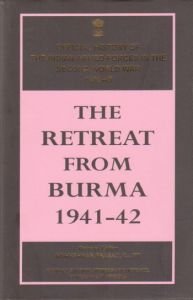
Official History of the Indian Armed Forces in the Second World War 1939-45: The Retreat from Burma 1941-42
Contents: Foreword. Introduction. 1. Burma the land and its people. 2. Burma history and politics. 3. Japanese aggression in the far east. 4. Danger of the invasion of Burma. 5. Armed forces in Burma. 6. First attack. 7. Loss of Mergui and Tavoy. 8. Action in Kawkareik sector. 9. Defence of Moulmein. 10. Salween line—Martaban and pa-an. 11. Bilin line. 12. Battle of the Sittang River. 13. Operations in the Pegu area. 14. Fall of Rangoon. 15. Operations in the Shan states and Karenni. 16. Regrouping of Force after the fall of Rangoon. 17. Entry of the Chinese expeditionary force. 18. Withdrawal from prome. 19. Race for the oilfields-Minhla Taungdwingyi line. 20. Race for the oilfields. 21. The beginning of the end-retreat North of Mandalay. 22. Pursuit-action at Monywa. 23. End-race for Kalewa. 24. The Chinese front 2nd phase. 25. Capture of Akyab. 26. Campaign in the air. 27. Civil and Military administration. Appendices. Bibliography. Index.
At the end of the Second World War, a Historical Section was set up, under the Ministry of Defence, to write a detailed history of war, with particular reference to the operations conducted by the Armed Forces of undivided India. After the partition of the country in 1947, this section continued as a joint organization of India and Pakistan and was designated as the Combined Inter Services Historical Section (India and Pakistan). The CIS Historical Section compiled 25 volumes until it was wound up in 1963.
Meanwhile, a separate section called historical section (India) was set up in 1953 for compiling the history of post-partition military operations of the Indian Armed Forces. This section was also meant to supply information on military history and allied subjects to the Ministry and the three Services headquarters. Subsequently a heraldic cell was created within the Section to advise the Ministry and the Armed Forces on Ceremonial matters.
Since its inception in 1953, the Historical Section has brought out fifteen publications. In view of the growing responsibility of the section, it was redesignated as the history division on April 1, 1992.
The History Division also serves as a record, research and reference office of the Ministry of Defence and three Services Headquarters. Officers of the Indian Armed Forces and research scholars often visit the Division to consult records of military importance. The division also assists various units of Armed Forces in compiling their histories. (jacket)
