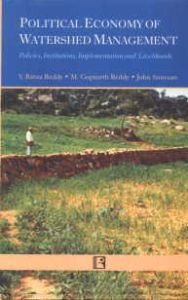
Political Economy of Watershed Management : Policies, Institutions, Implementation and Livelihoods
Contents: Foreword. Preface. 1. Introduction. 2. Watershed Management: The Context. 3. Watershed Management: Policy Context. 4. Watershed Management : Institutional Context. 5. Implementation and Sustainability. 6. Watershed Management and Rural Livelihoods. 7. Participation and Impact: GO-NGO Syndrome. 8. Collective Action and Watershed Management. 9. Political Economy of Watershed Management. References. Index.
“Over the decades watershed development in India has transformed from purely soil and water conservation technology to a comprehensive rural development programme. Watershed development programme is among the flagship programmes for rural development in India.
The book, in the backdrop of Andhra Pradesh, looks at the watershed development programme in a historical perspective and covers a number of important issues such as policies, implementation, livelihood impacts, sustainability and political economy of the programme. At the policy level, the book identifies some of the lacunae like property rights and the linkages between property rights and collective action. As far as the implementation of the programme is concerned, the book emphasizes that the core philosophy of the policy makers dealing with natural resources has not changed despite numerous changes at the macro level. The livelihoods analysis brings out the fact that watershed management is a necessary but not a sufficient condition to sustain rural livelihoods in a wider context. But, it holds the potential for enhanced livelihood security even in the given geo-climate conditions where watershed cannot bring direct irrigation benefits on a large scale. The institutional framework stresses the importance of policy and political environments for institutional innovation and sustainability.
The book will be of immense help to scholars, researchers, analysts, commentators, academicians, policy makers and implementers."(jacket)
