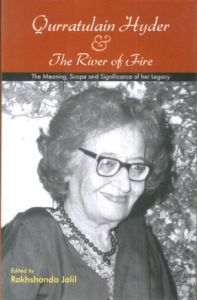
Qurratulain Hyder and the River of Fire : The Meaning Scope and Significance of Her Legacy
Contents: Introduction. Personal portraits: 1. A rainbow of reminiscences/Huma Hyder Hasan. 2. Talking to Aini Khala/Noor Zaheer. 3. Qurratulain Hyder: the first lady of Urdu literature/Khalid Hasan. Critical narratives: 4. Qurratulain Hyder: an author par excellence/Gopichand Narang. 5. The enigma of dual belonging: Qurratulain Hyder\'s enduring popularity in Pakistan/Raza Rumi. 6. Post-colonialism and marginality in the fiction of Ismat Chughtai, Khadija Mastur and Qurratulain Hyder/Fatima Rizvi. 7. Once upon a time: cultural legacies, fictional worlds of the partition and beyond/Asif Farrukhi. 8. Amma, Basant Kya Hoti Hai?: turns of centuries in Aag ka Darya/Sukrita Paul Kumar. 9. History and fiction: the depiction of 1857 in Qurratulain Hyder\'s fiction/Mohammad Sajjad. 10. The creative genius of Aini/Syed Mohd Ahraf. 11. Qurratulain Hyder and the partition narrative/Shamim Hanfi. 12. Lost/found in translation: the author as a self-translator/M. Asaduddin. Textual appraisals: 13. Imagining India: in and as the river of fire/Rakhshanda Jalil. 14. Representation of the female psyche: the Champa of Aag ka Darya/Sami Rafiq. 15. The configural mode: Aag ka Darya/Kumkum Sangari. 16. Transcreating history: a reassessment of river of fire/M. Asim Siddiqui. Bibliography.
Born with an impeccable literacy lineage--her father was Sajjad Hyder Yildirim and her mother Nazr-e Sajjad Hyder, both early and vigorous proponents of Urdu fiction - Quarratulain Hyder wrote her first story at the age of 11. Her first collection of short stories, Sitaran se Aage, published in 1945, established two singular qualities about this rising star on the Urdu firmament: one, her steadfast refusal to write only on womanly subjects and two, her ability to consistently produce polished, lyrical prose at a time when poetry held sway. Over the years, she produced a formidable array of travelogues, translations, novels, plays novelettes ad short story collections.
This volume attempts to revisit her legacy and to place her work, critically and objectively on the trajectory of post-independence writing. It attempts, also to offer the River of Fire as a metaphor in which the writer must sink or swim whenever he/she chooses to cross from one bank to the other, that is, from the moment he/she crafts piece of writing to the time it is read and understood by his/her reader. A eclectic group of writers - from across disciplines, languages and nationalities - come together to locate Quarratulain Hyder in the continuum of post-independence studies. (jacket)
Born with an impeccable literacy lineage--her father was Sajjad Hyder Yildirim and her mother Nazr-e Sajjad Hyder, both early and vigorous proponents of Urdu fiction - Quarratulain Hyder wrote her first story at the age of 11. Her first collection of short stories, Sitaran se Aage, published in 1945, established two singular qualities about this rising star on the Urdu firmament: one, her steadfast refusal to write only on womanly subjects and two, her ability to consistently produce polished, lyrical prose at a time when poetry held sway. Over the years, she produced a formidable array of travelogues, translations, novels, plays novelettes ad short story collections.
This volume attempts to revisit her legacy and to place her work, critically and objectively on the trajectory of post-independence writing. It attempts, also to offer the River of Fire as a metaphor in which the writer must sink or swim whenever he/she chooses to cross from one bank to the other, that is, from the moment he/she crafts piece of writing to the time it is read and understood by his/her reader. A eclectic group of writers - from across disciplines, languages and nationalities - come together to locate Quarratulain Hyder in the continuum of post-independence studies. (jacket)
