Radical Ideology and \'Controlled Politics : CPI and the History of West Bengal 1947 -1964
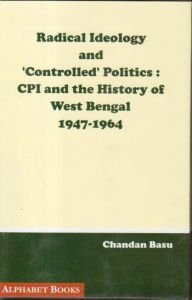
Contents: 1. Introduction : defining and limiting the periphery. 2. The Marxist theory of party formation: reconsidering Lenin and Mao. 3. Mapping history and politics: communism in Indian perspectives. 4. CPI and the political perspectives of West Bengal, 1947-1964. 5. Conclusion: re-questioning the limits of perspectives. Bibliography. Index.
The present book attempts to explore the role of the Communist Party of India (CPI) in the historical perspectives of West Bengal between 1947 and 1964. The year 1947 denotes both independence and partition, and the creation of a new state in India that is West Bengal. The year 1964 witnessed the division of the communist party. In post 1964 period, the newly born CPI (M) became the major political force in the political battleground of West Bengal. However, there were major political, economic, social and cultural developments in West Bengal between 1947 and 1964. In fact it is an emerging area of historical research attracting the attention of the scholars. This publication is an integral part of this growing interest about the post-colonial history writing. In this work, three distinct but interrelated themes have been discussed. These are the Marxist theory of party formation, the historiography of communist movement in India and the role of the CPI in the historical perspectives of West Bengal during the period under review. It argues that communist movement cannot be interpreted without analyzing the very structure of the communist party, primarily theorized and developed in Russia by Lenin in the beginning of the 20th century. (jacket)
