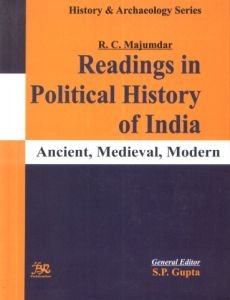
Readings in Political History of India : Ancient Medieval Modern
Contents: 1. Study of Indian History. 2. Rgvedic Civilization in the light of archaeology. 3. The Constitution of the Licchavis and the Sakyas. 4. Achaemenian Rule in india. 5. A Passage in Alberuni’s India – Nanda Era? 6. The Indika of Megathenes. 7. Some Observations on Pusyamitra and His Empire I. 8. Observations on Pusyamitra and His Empire II. 9. North India after the fall of the Maurya Empire. 10. King vikramaditya and vikramas Samvat. 11. The Date of Kaniska. 12. A Forged purana text on the imperial guptas. 13. Original home of imperial Guptas. 14. Literary reference to Samudragupta. 15. The Gaya and Nalanda Plates of Samudragupta. 16. The King Candra of the Meharauli Iron Pillar inscription. 17. The Successors of Kumaragupta I. 18. Bihar stone pillar inscription of skandagupta. 19. The successors of skandagupta. 20. The seal of Vainyagupta. 21. Vainyagupta Dvadasaditya. 22. The Revised chronology of the last gupta emperors. 23. Note on the genealogy and chronology of the vakatakas. 24. The Vakataka Queen Prabhavati-Gupta. 25. Harsavardhana – A Critical Study. 26. The extent of Harsavardhana’s Empire. 27. The Harsa Era. 28. Puiakesi and Khusru II. 29. The Gujara – Pratiharas. 30. Some Problems concerning Gujara –Pratiharas. 31. Arab Invasions of India. 32. Early Muslim Settlements in India. 33. Sultan Mahmud and the Sahiya Kings. 34. The Epoch of the Ganga Era. 35. Lord William Cavendish – Bentinck- A Revised estimate of his administration (1828-35) 36. Some Unpublished documents regarding the Mutiny of 1857.
The Readings in the Political History of India by the savant, it is hoped, will reveal his personality much better than his several voluminous publications since they contain his various thoughts and line of argument on several topics as they appeared first in the form of articles in many learned journals whose back issues are not available at all, in fact, many of them have become defunct. No one interested in Indian history can afford to miss them.
