Recent Trends in Animal Behaviour
Contents: Preface. List of contributors. I. Key note address and Plenaries: 1. Biological clocks in bats, mice and humans/M.K. Chandrashekaran. 2. Education scenario in India: need for new concepts and region oriented focus/Debjani Roy. 3. Behavioural studies on birds and conservation/Lalitha Vijayan. 4. The functional organization of an insect society/Raghavendra Gadagkar. 5. Status, distribution, food and feeding of Malabar Spiny Dormouse (Platacanthomys lasiurus Blyth) in the Western Ghats of Kerala/E.A. Jayson and K.M. Jayahari. 6. The science and art of monitoring wild tigers/K. Ullas Karanth. 7. Social cognition in primates: from mental representation to distributed cognition/Anindya Sinha. 8. Signallers and receivers: sensory ecology of acoustic communication in crickets/Rohini Balakrishnan. 9. Recent trends in ethology/Juliet Vanitharani. 10. Parsimony in insects/Geetha Bali. 11. Localisation of prey by young and adult Indian False vampire bats/H. Raghuram and G Marimuthu. II. Behavioural ecology: 12. Molecular approaches in behavioural ecology/Saikat Chakraborty. 13. Habitat use and response of Brown-hawk owl, Ninox scutulata to the broadcast of Conspecific calls/S.A. Babu and E.A. Jayson. 14. Effect of environmental factors and Typhoon's flooding on the population dynamics of Benthic fishes in Hapen Creek of Northern Taiwan/Hema Krishnakumar, Hsiung Liang, Chi-Chang Liu and Yao-Sung Lin. 15. Leaf-selection and tent construction by the Indian short-nosed fruit bat Cynopterus sphinx (Chiroptera : Pteropodidae) in the Palm, Borassus flabellifer/R. Rajasekar and K. Sripathi. 16. Bat pollination syndromes in few species of plants/P. Thiruchenthil Nathan, Irulan and G. Marimuthu. 17. Movement of coconut Eriophyid Mite, Aceria guerreronis Keifer on nut surface: a behavioural study/B. Mallik, J. Jayappa and H. Guruprasad. 18. Account of an architect queen/Maulishree Agrahari and Raghavendra Gadagkar. 19. Behavioural difference and diversity of males and females of two primitively Eusocial wasps/Ruchira Sen and Raghavendra Gadagkar. 20. Activity patterns of Grey Jungle Fowl, Gallus sonneratii at Gudalur Range in Theni Forest Division, Western Ghats, Tamilnadu, South India/N. Ramesh and M.C. Sathyanarayana. 21. Analysis of route learning ability of Climbing Perch, Anabas testusineus/T.P. Avinash, V.V. Binoy and K. John Thomas. 22. Predator avoidance behaviour of Naive Juveniles of Puntius Sarana: a freshwater fish/John Shiron, V.V. Binoy and K. John Thomas. 23. Influence of hunger on food stocking behaviour of Climbing Perch, Anabus testudineus/V.V. Binoy and K. John Thomas. 24. Diel activity and diversity of butterflies visiting nectar host plants in dryland-scrub ecosystem/J. Jayappa, M. Muralikrishna, Revanna Revannavar, Mahadevappa, K. Devaraj, K. Chandrashekara and A.R.V. Kumar. III. Social behaviour and physiology of behaviour: 25. Physiology of behaviour of White Leghorn Chick (Gallus domesticus) exposed to pesticides/Sowmini Balakrishnan. 26. Finding an appropriate index to construct dominance hierarchies in the primitively Eusocial wasps, Ropalidia marginata and Ropalidia cyathiformis/Alok Bang, Sujata Deshpande, A. Sumana and Raghavendra Gadagkar. 27. Scent marking by free-ranging dogs (Canis familiaris)/S.K. Pal. 28. How do workers of the primitively Eusocial Wasp, Ropalidia marginata detect the presence of their queens?/Anindita Bhadra, Priya L. Iyer, A. Sumana, Sujata A. Deshpande, Saubhik Ghosh and Raghavendra Gadagkar. 29. Transition of an aggressive potential queen to a docile queen in the primitively Eusocial Wasp, Ropalidia marginata/Aniruddha Mitra and Raghavendra Gadagkar. 30. An observational study on the behaviour of Chimpanzee (Pan troglodytes) in captivity at National Zoological Park, Delhi Zoo/Samina H. Farooqi, Satish Kumar and H.S.A. Yahya. 31. Stress-induced behavioural changes in a novelty test in the domestic chick/Reshma Shetty and Monika Sadananda. 32. A study on the reproductive physiology of a captive pair of Chimpanzee (Pan troglodytes) in National Zoological Park, New Delhi/Samina H. Farooqi, H.S.A. Yahya and Iqbal Perwez. 33. Expression of red/green color sensitive Opsin in Chiroptera: a prime report/C. Kanagaraj and K. Emmanuvel Rajan. IV. Foraging and feeding behaviour: 34. Feeding behaviour of Cardamom Shoot and and fruit borer (Conogethes punctiferalis Guanee) Larvae in laboratory/N.E. Thyagaraj, P.K. Singh and A.K. Chakravarthy. 35. Species diversity of rodents collected from bamboo flowering areas of Mizoram and their feeding behaviour/N.S. Azad Thakur, A.N. Shylesha and D. Kumar. 36. Developmental behaviour of Rice Hispa, Dicladispa armigera Oliver (Coleoptera: Chrysomelidae) in Coastal Karnataka/L. Vijay Kumar, S.U. Patil and A.K. Chakravarthy. 37. Response of pure silkworm, Bombyx mori L. Breeds to feeding methods and feeding sequences of Mulberry varieties/K.P. Chinnaswamy, Changalarayappa, S. Fatima, K. Rashmi and N. Jagadish. 38. Feeding potential of Amblyseius herbicoloides Mcmurtry and Moraes (Acari : Phytoseiidae) on selected Tetranychid pest mites/U.M. Sheeja and N. Ramani. 39. Foraging and feeding behaviour of Indian crested Porcupine (Hystrix indica Kerr) in wild and cultivated areas of Western Ghats of Karnataka/A.K. Chakravarthy, A.C. Girish and N.R. Prasanna Kumar. 40. Feeding behaviour of selected insect predators on Sugarcane Woolly Aphid, Ceratovacuna lonigera Zehnter (Homoptera: Aphididae) in South Karnataka/K.N. Muniswamy Gowda, A.K. Chakravarthy and L. Vijay Kumar. 41. Magnitude of food preference and consumption by soft-furred field rat, Millardia meltada (Gray) under laboratory conditions/P. Sakthivel and P. Neelanarayanan. 42. Oriental responses of shoot and fruit borer, larvae, Conogethes punctiferalis Guenee (Pyralidae: Lepidoptera) towards selected plants in laboratory/A.K. Chakravarthy, B.S. Basavaraju and E. Ganagappa. 43. Foraging behaviour of honey bee and its role in fruit set in cucumber/N.S. Bhat, H.S. Satish and H.M. Yashwant. 44. An inexpensive technique for mass rearing of Pod Borer Helicoverpa armigera (Hubner)/A. Shobha, Manjula Kumari and Geetha Bali. 45. Diverse feeding trends in a primitive Oribatid Mite, Archegozetes longisetosus Aoki (Acari: Oribatei)/M.T. Shiji and N. Ramani. V. Applied behaviour: 46. Prevention of bird damage to maize cobs/T. Shivashankar. 47. Biodiversity--a biologist's perspective/S. Krupanidhi. 48. Validation of integrated pest management modules for the management of Shootfly in Rabi Sorghum/R.A. Balikai. 49. Mechanical control of Red-headed hairy caterpillar, Amsacta albistriga in groundnut/P.C. Ganiger and V.T. Sannaveerappanavar. 50. Bio-efficacy of ready-mix formulations of insecticides against Pigeon pea pod borer complex/P.C. Ganiger, D.W. Wadnerkar and M. Thippaiah. 51. Seed treatment as an eco-friendly management tactic for suppression of insect pests in Sorghum/R.A. Balikai. 52. Eco-friendly management of rodent pests using Tanjore-bow Trap in irrigated rice fields, Tiruchirappalli District, Tamil Nadu/P. Sakthivel, A. Bharathiraja and P. Neelanarayanan. 53. Efficacy of herbal products against pigeon pea pod borers/B.S. Nandihalli. 54. Management of Thrip complex in grape/N.D. Sunitha, S.B. Jagginavar, D.R. Patil and A.P. Biradar. 55. Testing of Bt Products for the management of Greater Wax Moth, Galleria mellonella L./A.B. Vishwas and Gavigowda. 56. Bat species survey--an effective tool for bat conservation in Agasthiyamalai Biosphere Reserve/Juliet Vanitharani and U.S.U. Malathi. 57. Relationship between frequency of bee visits and seed set in Niger/N.S. Bhat, C.J. Nagaraja, S. Suma and A.B. Vishwas. 58. Insect biodiversity in Grape ecosystem/N.D. Sunitha, S.B. Jagginavar, D.R. Patil and A.P. Biradar. VI. Reproductive and sexual behaviour: 59. Spermatophore deposition and sperm transfer in an Oribatid Mite Scheloribates praeincisus interruptus Berlese (Acari: Oribatei)/E. Julie and N. Ramani. 60. Behavioural development of two forms of Sorghum Shoot Bug, Peregrinus maidis (Ashmead) on Sorghum/L. Vijay Kumar, S.U. Patil and A.K. Chakravarthy. 61. Reproductive behaviour of Tetranychus neocaledonicus andre (Acari: Tetranychidae) infesting Moringa oleifera Lam/Sangeetha G. Kaimal and N. Ramani. 62. Biology, adult emergence and mating behaviour of Melon Fly, Bactrocera Cucurbitae coquillett (Diptera : Tephritidae)/V. Shivayya, C.T. Ashok Kumar, A.K. Chakravarthy and A.H. Jayappa. 63. Mating and Ovipositional behaviour of the Indian Uji Fly, Exorista bombycis Louis, a parasitoid of the Mulberry Silkworm, Bombyx mori L./S. Fatima, C. Siddapaji, K.P. Chinnaswamy and K. Rashmi. 64. Influence of mating on the temporal Oviposition patterns of Helicoverpa armigera and Bombyx mori/A. Shobha, D. Manjula Kumari and Geetha Bali. 65. Female remating in Drosophila : Relationship between frequency of remating and duration of copulation/Chaya Kumari and S.R. Ramesh. 66. Cold blooded love behaviour in insects and freck occurrence in human beings/K. Marimuthu, M. Kanimozhi and Panjaly Ramaraj. 67. Behavioural and molecular genetic evidence of mating strategy in the Polygynous mating Bat Cynopterus sphinx/T. Karuppudurai, N. Gopukumar and K. Sripathi. 68. The effect of dark/light cycle on mating propensity and productivity in Drosophila/H.K. Jyothi and B.P. Harini. 69. An experimental set up to study mating in captivity in the primitively Eusocial Wasp, Ropalidia marginata/Swati Samudre, Rutuja Chitra Tarak, Ruchira Sen and Raghavendra Gadagkar. 70. Dominant deriving a boost by suppressing the subordinate: A study on a primitively Eusocial Wasp, Ropalidia marginata/Vidhi Pareek and Raghavendra Gadagkar. 71. Seasonal variation in the size of nasal gland in two sympatric species of Hipposiderid Bats/D.P. Swami Doss, K. Sripathi and N. Gopukumar. Recommendations of the XXXI Annual Conference of Ethological Society of India. Subject Index.
"Studies on animal behaviour are vital for several reasons most importantly in connection with conservation, livestock and wildlife management, animal welfare, sustainable use of animal and human resources, and ultimately for better understanding of human behaviour. In its formative stages, behavioural studies were mostly observational till the classical work of Lorenz, Tin Bergen and Frisch catapulted them into Nobel laureates. This had a cascading effect on research on animal behaviour resulting in intense studies in several areas of behaviour mainly information acquisition (Neuroethology) and transfer (communication), ecological aspects (habitat related, foraging strategies, migration, predator-prey interactions, population ecology etc.), socio-biology (parent-filial interactions, co-operation and conflict, grouping and dispersion, social organization etc.) reproductive strategies, evolutionary aspects (kin selection, altruism, life history strategies etc.), physiology (behavioural endocrinology, rhythms, neurobiology) and applied behaviour (conservation, animal welfare, livestock production, wild life management, man animal conflict etc.)
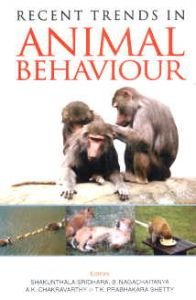
Recent trends in Animal Behaviour is a compendium reflecting contemporary trends in the study of animal behaviour ranging from organization of insect societies to monitoring of tigers. It is a rich source of information on biological rhythms, behavioural ecology, social behaviour, physiology of behaviour, molecular markers in behavioural studies and applied aspects of behaviour. The sheer range of animals studied makes the book a virtual treasure of information on tropical fauna. The animals investigated are: Mites, a wide variety of insects, silkworm, honey bee, Drosophila, wasps, butterflies, domestic chick, jungle fowl, rodents, bats, dogs, monkeys, chimpanzees and tigers, some in laboratory but a majority in their natural habitat making the book an important contribution to animal behaviour studies and a highly useful reference source for students and researchers alike in this field."
