Rethinking Western India : The Changing Contexts of Culture, Society and Religion
Contents: Introduction: The Semantics and Mechanics of Region-Maharashtra and its Contexts/Dusan Deak and Daniel Jasper. I. The Semantics of the Social: The Worlds of Texts and Meanings. 1. The World of Two Dhangar Ovis/Anne Feldhaus. 2. Bidar in the Marathi World: Saints, Kings and Powers across the Centuries/Dusan Deak. 3. A Socio-Textual Ecology of the Rgvedasagrantha/Cezary Galewicz. 4. Gender and the Freedom Struggle in Maharashtra: Contextualising Prema Kantak’s Novel Agniyaan (1942)/Meera Kosambi. II. The Mechanics of the Social: Agents and Agencies across the Spaces and Places. 5. Bhagwangadavarun Mala Mumbai Disate Aahe: How Caste Survives amidst Democratic Politics/Rajeshwari Deshpande. 6. Of Relics and Living Traditions: Creating Heritage in Maharashtra/Daniel Jasper. 7. A City of Yesterday in the World of Tomorrow: Urban Solapur and Declining Industry-Its Impact on Women/Piyul Mukherjee and Rajneesh Krishna. 8. The Changing Environment of Political Protest: Construction and Contestation of Political Space in Mumbai/Aruna Pendse. 9. Trade Network in Indapur Pargana under the Marathas/Michihiro Ogawa. 10. The Kolis of Mumbai: The Vanishing People/Jayant Bhalchandra Bapat. III. Beyond Maharashtra: Locating and Rewriting the Pasts. 11. Ambiguity in University Autonomy: The University of Bombay in its City in the Late Nineteenth Century/Jim Masselos. 12. Mal Khara Tol Poora: Aspiration and Reality in the Monetary Environments of Eighteenth-Century Maharashtra/Shailendra Bhandare. 13. Politics of Maharashtra and Its Environments/Suhas Palshikar.
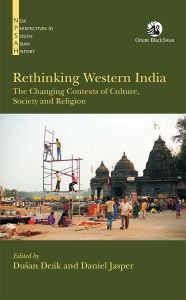
While investigating the cultural, social and political dynamics in Maharashtra, Rethinking Western India looks into the relations and processes that make up what are usually thought to be regional problems.
The essays show how the regional must be understood in contexts that supersede the region and geographical determinism.
The opening essays not only contextualise Maharashtrian texts as coherent wholes, but also the meanings contained within these texts, thereby addressing “the semantics of the social”.
A focus on “the mechanics of the social”-the interface of actions that articulate societal relationships at different levels, and of different characters-is attempted by the next set of essays.
The concluding essays emphasise how local dynamics are as much a part of forces ostensibly “beyond Maharashtra”, as they are products of dynamics within Maharashtra. There is, therefore, a deep analysis of the social and cultural referents upon which collective identities are built.
