Shri Vishnu Sahasranama Stotram: The Thousand Glorious Names of Bhagavan Shri Vishnu
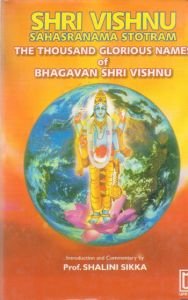
Contents: 1. Introduction. 2. Dialogue between Yudhishthira and Bhisam Pitamaha. 4. Commentary. 5. Special method of worshipping Bhagavan Shri Vishnu. Index. (One chapter is in Sanskrit).
The Vishnu Sahasranama Stotram or Hymn extolling Bhagavan Vishnu in his glorious one thousand names occurs in the Mahabharata. It is recited by Bhisma in answer to Yudhishthira’s following questions about the highest dharma, the ultimate goal of life:
1. Who is the primordial God?
2. What is the ultimate goal-that which is describing Goal of all human existence?
3. Who is to be praised by word of mouth?
4. Being deserted to whom, men attain peace and prosperity?
5. Which is the best among the righteous deeds that you know?
6. By meditating upon what does man attain freedom from the cycles of births and deaths?
Bhishma stated that by chanting incessantly the thousand holy and glorious names of Shriman Narayana, the Lord of the Universe, the infinite, the giver of desired gifts, Bhagavan Shri Vishnu man crosses over the eddy of sorrow.
Bhishma, after thus indicating the greatness of this garland of the thousand holy names of Bhagavan Shri Vishnu, recited in 107 stanzas (slokas), the one thousand names in succession. In an epilogue of 22 stanzas (slokas) he further elucidated the greatness (the reward, phala-shruti) of Shri Vishnu and the efficacy of this hymn of divine names. The names that make up Sahasranama are all descriptive (gaunani) of his excellences, exploits and glorious attributes. Each of these glorious names carries great significance. Some referrer to his power and beauty, others recall some incident in mythology of Shri Vishnu whose compassion sustains the world. He upholds the cosmos from within, as its ruling principle, and establishes and embodies dharma-the strong and the indivisible unity of life. (jacket)
