South Asian Terracotta through the Ages C.7000 B.C.-578 A.D. (3 Vols-Set)
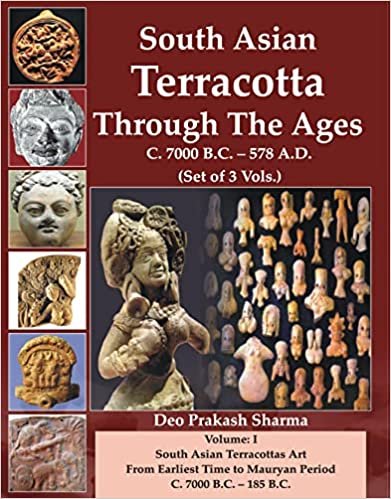
This book ‘South Asian Terracotta Art Through the Ages’ are in three volumes. These are documentation work of Terracotta Art which are mostly in India and some rare items of Pakistan and other countries his Volume I covers mostly Harappan and Mauryan Terracotta Art. This is photo documentation of rare Harappan, Post Harappan and Mauryan Terracottas objects. Till today we have excavated 252 Harappan sites in north west part of south Asia. The art style of the Early Harappan terracotta art is primitive and these are hand made. Their facial contour is absent and bare breasts are mostly round in shape, which represents fertility cult. The bottle shaped terracotta mother goddess figurines having bird like face and joint legs shows Iranian influence in this region. With the mature Harappans first urban stage (3000-1900 B.C.) began a new era of terracotta art, produced a large variety of terracottas and in great quantities at urban sites like Dholavira, Banawali, Rakhigarhi, Baror, Bhirrana, Lothal, Chanhudaro, Kalibangan, Nausharo, Nagwada, Harappa and Mohenjodaro. Most of these are hand-made by pinching and appliqué method. The mature Harappans also rarely used single mould technique and few puppet masks discovered from Mohenjodaro and Harappa were mould made and majority of the Harappan terracotta are solid.
Second volume is on Sunga Kusana and Satavahana Terracottas Art. The Shunga artists of the 2nd and 1st centuries B.C. brought revolution in the field of terracotta art by introducing once again the technique of single mould which led to mass production and standardization of figuring’s. For the first time, themes and legends from ancient literature, scenes from everyday life and various icons etc. formed the subject matter to terracotta art. A large number of Shunga terracottas have been found at Patna, Buxur, Kausambi, Mathura, Chandraketugarh, Tamluk etc. Around late 1st c. B.C. double mould terracottas were prepared by Sunga artists of Chandraketugarh and Kausmabi. Which was continued during early Kushana age (50 B.C. TO 100 A.D.).
The Satavahana terracotta artist in North Deccan, from the 2nd c. B.C.- 2nd c. A.D. used white kaolin soil to produce figurines. Kaolin soil is much finer material than clay. They had mastered the art of producing figures in round by the use of double mould, which is evident from the figures of Yakshas, Yakshis, horses and horse-riders found at sites like Ter, Kondapur, Mansur, Adam, Sanethi, Paithan and other places. One can also see the influence of Roman art i.e. they introduced double mould made terracottas, technique which were continued till Gupta period. Ornamented horse which was discovered from Ter confirms royal horse sacrifice (Ashvamedha) which was performed by Satavahana rulers. The Kushan terracottas of the period from c. 50 B.C. mid to 3rd century A.D. present a cruder variety. Though the terracotta were produced on a large scale at Mathura, Ahichchhatra, Kaushambi, Kheradih, Newal and other places, still these were roughly modeled. A number of clay figures bearing Hellenistic influence have also been reported from Taxila, Gandhara and Akhnoor region which comprise human figures, Buddha, Bodhisattva images. They also used double mould.
The Gupta period c. 319-578 century A.D.), also known as or Classical Age of Indian art, produced terracottas of great variety and artistic excellence, unparalleled in the history of South Asian art. Gupta artists had mastered the technique of modelling and depiction of moods. The life-size image of Ganga and Yamuna and heads of Shiva and Parvati from Ahichchhatra and Hariti and Gaja Lakshmi from Kausambi are some of the best examples of Gupta terracottas. The temples built at Apsad in Bihar, Ahichchhatra and Bhitargaon in U.P. and Sirpur in Madhya Pradesh were embellished with large size terracotta panels of high relief depicting gods and goddess and scenes from the Ramayana and Mahabharata.
The Palas and Senas of Eastern India carried forward the tradition of Indian terracotta from the 8th to 12th century. Clay tablets depicting temples, shrines, Buddhist deities etc. from Bodha Gaya, Nalanda, Vikramshila, Paharpur, Antichak, Mainamati and other places form a distinct group of terracotta’s of this period. Terracotta art of religious icons sharply declined with the consolidation of Islamic rule, from about 1200 A.D. The artists of Bengal and Bihar are, however, credited with the revival of terracotta art from the 17th to the 19th century when the walls of temples were adorned with terracotta panels depicting mythological scenes from ancient literature and also contemporary scenes of everyday life. Maluti in Santhal Pargana (Bihar), Shyamrai temple and Jor Bangla temple at Bishnupur, Lakshmi-Janardhan temple at Singti are fine examples of revival of terracotta art. Terracottas are produced even today for different social and religious purposes, but the elegance and the excellence of the past could not be reproduced. The present day terracotta centres are Nilgiri (Tamilnadu), Golpara (Assam), Bakura (Bengal), Gorakhpur (U.P.) and Khojawa in Varanasi.
