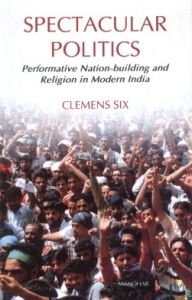
Spectacular Politics: Performative Nation - Building and Religion in Modern India
Contents: Preface. Introduction. 1. Politics, nationalism and religion in modern India. 2. Performative nation-building: religious rituals in Indian nationalism. 3. Beginnings of performative nation-building: Gandhi’s method of political communication. 4. Political rituals of purity in Colonial India. 5. Religion as a strategy of mobilization in democratic India. 6. Transformations of the public sphere: religion, politics and globalization. 7. Terrorism and religious violence in South Asia: the performative politics of fear. 8. Spectacular politics, power and constructed consensus: some conclusions. Abbreviations. Bibliography. Index.
How does one explain the historical processes through which abstract ideas such as the idea of a nation become a motivation for mass mobilization, political re -organization and even violence on a large scale? This book seeks to find answers to this question in the context of India’s modern history during its long eventful twentieth century.
Starting form the early stage of Gandhian mass mobilization after the First World War and subsequently proceeding to more recent examples of Hindu -nationalism, the book analyses ‘spectacular politics’ as a distinct form of political communication. It thereby seeks to understand not only how the idea of a nation turned into the most powerful political idea in modern India, but also how political communication and mobilization work in an extremely heterogeneous and fragmented society. As Indian society becomes more and more involved with globalization and internationalization, many seemingly self-evident paradigms of India’s self-understanding such as its national identity, democracy, or secularism are once again subject to intense political controversies and social confrontations.
Finally, the example of religiously motivated terrorism illustrates the profound ambivalence of performative politics between inclusive, even participatory effects on the one hand and destabilizing, even destructive consequences of those political discourses, which emphasize their form as much as their content.
