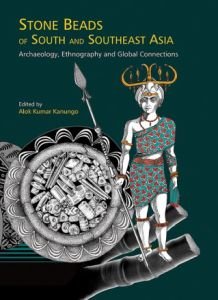
Stone Beads of South and Southeast Asia: Archaeology, Ethnography and Global Connections
Contents: Preface. Introduction. I. Beads: Importance and Literature: 1. Small Find, Immense Impact: Importance of Bead Studies/Kishor K. Basa. 2. Jewels and Jewellery in Early Indian Archaeology and Literature/R.S. Bisht. 3. Beads and Ornaments in Early Tamizh Texts/V. Selvakumar. 4. Ratnattin Tiruvābharaṇaṅgal (Sacred Gemstone Ornaments) in the Inscriptions of Brihatīswarā Temple, Tañcāvūr/V. Selvakumar. II. Beads: History, Methodology and Ethnoarchaeology: 5. Geological Aspects of Raw Materials for Stone Beads/Ravi Prasad, V.N. Prabhakar and Vikrant Jain. 6. History of Stone Beads and Drilling: South Asia/Jonathan Mark Kenoyer. 7. Stone Beads of the Indus Tradition: New Perspectives on Harappan Bead Typology, Technology and Documentation/Jonathan Mark Kenoyer. 8. Living Tradition: Stone Bead Production in Khambhat—An Ethnoarchaeological Approach/Kuldeep K. Bhan, Jonathan Mark Kenoyer and Massimo Vidale. 9. Transitions in the Stone Beadmaking at Khambhat: An Ethnohistorical Survey/Alok Kumar Kanungo. 10. Stone Bead Users - Symbolic Value and Trade: The Nagas/Manabu Koiso, Hitoshi Endo and Ayumu Konasukawa. III. Beads: Case Studies from South Asia: 11. Early Evidence of Beadmaking at Mehrgarh, Pakistan: A Tribute to the Scientific Curiosity of Catherine and Jean-François Jarrige/Massimo Vidale, Maurizio Mariottini, Giancarlo Sidoti and Muhammad Zahir. 12. Stone Bead Production through the Ages in Gujarat/Kuldeep K. Bhan. 13. Early Harappan Bead Production in Gujarat: Technology, Adaptation and Contacts/P. Ajithprasad and Marco Madella. 14. Documentation and Analysis of Stone Drills from Dholavira/V.N. Prabhakar. 15. Antiquity of Semi-precious Stone Beads from Deccan/Rabindra Kumar Mohanty. 16. South Indian Stones Beads: Archaeological, Textual and Ethnographic Approach to Traditional Gemstone Industry/K. Rajan. 17. Early Historic Stone Beads from Ahichhatra/Bhuvan Vikrama. 18. Ancient Stone Beads of Southeast Asia and Indian Connection/Bunchar Pongpanich. IV. Beads: Scientific Studies: 19. Scientific Analyses and Stone Beads/Laure Dussubieux and Mark Golitko. 20. Non-Destructive Identification and Characterization of Ancient Beads: A Case Study from Harappa/Randall Law. 21. Using SEM to Study Stone Bead Technology/Jonathan Mark Kenoyer.
Stone Beads of South and Southeast Asia: Archaeology, Ethnography and Global Connections is by far the most comprehensive book on stone beads. With contributions from 25 leading scholars from 17 research institutions of eight countries, the book dwells on related matter from ancient as well as modern India and other regions of South Asia.
Stone beads have gained the reputation of being one of the most important markers of prehistoric technological complexity, especially in South Asia. Their study is crucial for understanding our past contacts, technology and trade, besides comprehending our mastery over material culture and the procurement of diverse raw materials. Keeping this in mind, this book discusses, with the help of literary and epigraphical references, the development of stone beads through the ages, the utility and fruitfulness of typologies, the techniques historically used in their production and finally the modern scientific procedures which can be used in their study to better understand and interpret the past technology. It also deals with ethnohistorical studies of Khambhat (Cambay) to understand the historical development of the city-the most prominent traditional stone bead industry of the world-since the crafts started there, and ethnographical studies to know the symbolism behind the aggressive use of particular products.
The combined output of this book is a result of long-term fieldwork and experimental and scientific studies in laboratories in not only answering the statics of beads like 'when' and 'where' but also cognitivism, that is, 'why' and 'how'.
