Strengthening SAARC : Exploring Vistas for Expanded Cooperation
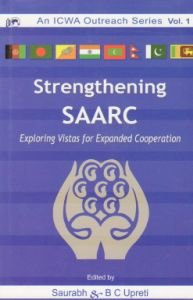
Contents: Preface. 1. Addressing human security concerns in South Asia: the role of SAARC/Nalini Kant Jha. 2. Conceptualising human security in the age of globalisation/Sudha Mohan. 3. Non-traditional issues of security in South Asia: challenges and prospects/Rajesh Kumar. 4. Challenges of governance and security in South Asia/Satish Kumar. 5. Gender as a component of human security in South Asia: the case of Pakistan/S.N. Kaushik. 6. Refugees in South Asia and security challenges: intervention of SAARC/Bhavna Sharma and Sourabh Sharma. 7. Ethnic conflict and security in South Asia: a study of Tamil conflict in Sri Lanka/Krishan Gopal. 8. Migration and security in South Asia/Vinod K. Bhardwaj and Geeta Sharma. 9. Health problems in South Asia: challenges before SAARC/Hareet Kumar. 10. Food processing: an emerging element in new perception of food security/Roopali Sharma. 11. International trade and economic threats in South Asia: addressing through SAARC/Monika Kannan. 12. Challenges in ensuring food security and livelihood in South Asia: role of SAARC/Hema Yadav and Sarwar Ali. 13. Human development and right to food security/Satya Bhan Yadav. 14. Climate change and regional cooperation in South Asia/Suman Sharma. 15. Securing environment in South Asia: role of SAARC/B.C. Upreti. 16. Cooperation for energy security in South Asia: challenges and options/Sanjay Bhardwaj. 17. Energy security in South Asia: challenges before SAARC/Sunita Pachori. 18. SAARC: engaging the Gulf\'s look east policy for non-traditional security threats/Sameena Hameed. 19. Forward looking SAARC/Aparna. 20. New factors in China\'s South Asia policy/Sanjeev Kumar. 21. Migration and security problems/Archana Gupta. 22. SAARC consciousness and role of South Asian University/Saurabh. Index.
In the post-cold war era, there is a serious rethinking on the concept of the security. Nations have started putting greater emphasis on the multi-dimensional character of security. There is a sharp transformation of the concept from a narrow state centric approach to a comprehensive security paradigm, based on the notion of human security. Thus, the importance of non-military and diplomatic methods in tackling security problems has increased. Problems of internal security including armed separatist movement and domestic ethnic strife, destructive consequences of drug trafficking particularly in developing countries have altered the security environment. The issues like social conflicts, food scarcity, underdevelopment, deprivation, poverty, civil war, climate change, energy crisis, non-participatory governance, etc have become major challenges to human security. The rate of financial growth is overcrowding the planet, adding to the enormous pressures on the diminishing non-renewable resources. This growth, at the root of much of global poverty, international migration and environmental degradation are unprecedented. This does not mean to suggest that the traditional security threats have become irrelevant. But the non-traditional security concerns have gained much prominence in the present context.
This book focuses upon a number of non-traditional security issues that the South Asian countries are facing with such as, governance, ethnicity, problem of refugees, migrations, gender, food scarcity, health hazards, environment, energy and external factors. The book tries to find out the role of SAARC in this regard and focus to bring out a regional approach to security in South Asia. It is hoped that the book will be useful to the students, academicians of South Asian affairs and for the concerned policy makers. (jacket)
In the post-cold war era, there is a serious rethinking on the concept of the security. Nations have started putting greater emphasis on the multi-dimensional character of security. There is a sharp transformation of the concept from a narrow state centric approach to a comprehensive security paradigm, based on the notion of human security. Thus, the importance of non-military and diplomatic methods in tackling security problems has increased. Problems of internal security including armed separatist movement and domestic ethnic strife, destructive consequences of drug trafficking particularly in developing countries have altered the security environment. The issues like social conflicts, food scarcity, underdevelopment, deprivation, poverty, civil war, climate change, energy crisis, non-participatory governance, etc have become major challenges to human security. The rate of financial growth is overcrowding the planet, adding to the enormous pressures on the diminishing non-renewable resources. This growth, at the root of much of global poverty, international migration and environmental degradation are unprecedented. This does not mean to suggest that the traditional security threats have become irrelevant. But the non-traditional security concerns have gained much prominence in the present context.
This book focuses upon a number of non-traditional security issues that the South Asian countries are facing with such as, governance, ethnicity, problem of refugees, migrations, gender, food scarcity, health hazards, environment, energy and external factors. The book tries to find out the role of SAARC in this regard and focus to bring out a regional approach to security in South Asia. It is hoped that the book will be useful to the students, academicians of South Asian affairs and for the concerned policy makers. (jacket)
