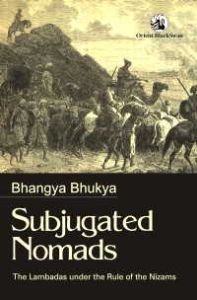
Subjugated Nomads : The Lambadas Under the Rule of the Nizams
Contents: Illustrations. Preface. Acknowledgements. Note on Translation. Abbreviations. Map of Hyderabad State in 1911, showing districts. Introduction. 1. The Twilight World of the Caravan: Regulated Market. 2. Policing Cattle, Policing Nomads: Colonial Rationality and Cowherds. 3. 'Delinquent Subjects': Dacoity and the Creation of a Surveillance Society. 4. Modern Forms of Land Relations: Exploitation and Revolt. 5. Articulating Cultural Differences, Contesting Power: The Consolidation of the Lambadas as a Social and Political Entity. Conclusion. Appendix. Glossary. Bibliography. Index.
"This book traces the historical transition of the Lambada community of Hyderabad State under the Nizams during colonial rule. The study spans nearly two centuries--from the early eighteenth to about the middle of the twentieth century. The author shows how this community, originally caravan traders, confronted the colonial or modern state power which had adversely transformed their lives.
The market economy and growth of transport hampered the Lambadas' caravan trade. The state discouraged their nomadic ways, inducing them to become peasants on wastelands and in forest tracts. From the middle of the nineteenth century, they had to depend on cattle-raising and agriculture, often becoming agricultural labourers. The state came to view their extension of agriculture as a threat to forest conservation, subjecting them to harassment and eviction. They began losing their plots of land through usurious money-lending and extortion. Zamindars claimed rights over wastelands, and extracted taxes. Exploitation by various agencies reduced the Lambadas to working as bonded labourers on farms. During famines and the off-season, some resorted to dacoity. This led the state to brand them as a criminal community and relocate them as ‘criminal tribes' under surveillance. Protracted suffering and victimisation compelled the Lambadas to revolt, which was transformed into the Telangana armed struggle at the end of the Nizams' rule.
The Lambadas had tried to respond to the challenges faced through a programme of self-reform. From the 1820s, leaders emerged from within the community, who rearticulated Lambada history, spiritual beliefs and culture. These find expression in the oral tradition which was crucial in shaping their community identity, now a significant element in democratic politics."
