Terrorism : Concepts and Problems
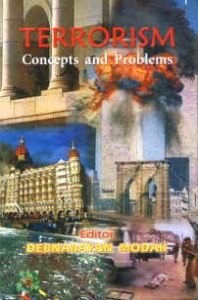
Contents: Preface. Introduction/Debnarayan Modak. I. 1. Terrorism, state and civil society/Swapan Kumar Pramanick. 2. Understanding terrorism : challenges and perspectives/Radharaman Chakrabarti. II. 1. Terrorism-conceptually speaking/Apurba Kumar Mukhopadhyay. 2. Terrorism today : a few observations/Gautam Kumar Basu. 3. The profile of terrorism in the 21 century/Anindya Jyoti Majumdar. 4. Terrorism and the problem of the liberal state/Rakhahari Chatterji. 5. Terrorism and the liberal state in the phase of globalization : towards a conceptual framework/Raj Kumar Kothari. 6. A critique of terrorism : the Gandhian paradigm context, construction and relevance/Tarun Kumar Banerjee. 7. Cyber-terrorism : terrorism in the information age/Ambarish Mukherji. 8. Understanding Jihad/Syed Abdul Hafiz Moinuddin. III. 1. Towards understanding religious terrorism or how not to read a Jihadi\'s mind/Amartya Mukhopadhaya. 2. The anatomy of terror : a nationalist perspective/Rajasri Basu. 3. Terror and the deficit of democracy : some reflections/Samir Kumar Das. 4. Terrorism, war on terror and human rights : a choice between Scylla and Charibdis?/Sekhar Ghosh. 5. State and terror : the case of Bangladesh/Partha Pratim Basu. 6. Combating terrorism : the U.N. Efforts/Debnarayan Modak. Index.
"The \'spectre of terrorism\' is haunting the world today. As a part of the world wide debates and deliberations on such a crucial problem of humanity, a good number of scholars including some renowned political scientists met in a Seminar in the Department of Political Science with rural administration, Vidyasagar University, Midnapore, to reflect on different aspects of it. The revised versions of some of the important contributions made in the seminar are now being presented under two covers. It carries a wide range of issues involved including more than one case-studies. The articles contained in the volume are the fruits of original research and are hitherto unpublished. The book may be of great help not only to the students, teachers and scholars of political science and other branches of social sciences, but also to the cross-sections of academicians, politicians, policy-makers, as well as the general readers, who feel themselves concerned about the plight of humanity at this critical juncture of history."
