That Which Is Not Drawn : William Kentridge and Rosalind C. Morris in Conversation
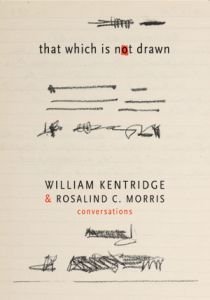
For more than three decades, William Kentridge has been exploring the most vexing questions of our time: the nature of subjectivity, the possibilities of revolution, the legacy of the Enlightenment in Africa and thought about time itself. While doing so, his work has pushed the boundaries of the media in which he poses these questions, allowing viewers to reflect with him on the tasks and the limits of representation, the traditions of landscape and self-portraiture, the possibilities for animated drawing and the labour of art.
For five days, Kentridge sat with Rosalind Morris to talk about his work. In this book, the result of that remarkably wide-ranging conversation, they probe as deeply into the techniques by which Kentridge works as the psychic and philosophical underpinnings of his oeuvre. Kentridge elaborates several key concerns of his art, including the virtues of bastardy, the ethics of provisionality, the nature of translation and the activity of the viewer. And together they trace the migration of images across his works, and think through the possibilities for a revolutionary art that remains committed to its own transformation.
Always seeking to evade confinement—by medium, by discourse, by political piety—Kentridge avows the conversational form as a process of invention: ‘That’s the thing about a conversation. The activity and the performance, whether it’s the performance of drawing or the performance of speech and conversation, is also the engine for new thoughts to happen. It’s not just a report of something you know.’(jacket)
