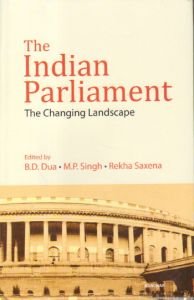
The Indian Parliament : The Changing Landscape
Contents: Introduction. I. The Dilemma of representation: 1. The paradox of political representation/Yogendra Yadav. 2. Debating Muslim political representation/Hilal Ahmed. 3. Exploring the interface between Parliament and society: women’s rights in India/Debi Chatterjee. II. Parliamentary performance: 4. Regional parties, coalition Government and functioning of Indian Parliament: the changing pattern/Sanjay Kumar. 5. Parliamentary control over executive: question hour/Moitree Bhattacharya. 6. Need for cooperative federalism in a Parliamentary system: the case of national counter terrorism centre/Manish Tewari. 7. The role of the Lok Sabha speaker/Anand P. Mavalankar. III. Parliament and judiciary: 8. Parliamentary privileges and immunities in India: an argument for codification/M.P. Singh. 9. Judicial review and limits of the privileges and powers of the Indian Parliament/Shibani Kinkar Chaube. 10. Chronicles of Parliament: the reservation debate/Rajeev Dhavan. IV. Decline of Parliament: 11. Declining Parliamentary behaviour: case of Democratic representation or institutional Decay/Amarjit S. Narang. 12. Election defection corruption/Chandan Mitra. 13. Representing a billion: Indian Parliament in its sixth decade/Ajay K. Mehra. V. Parliamentary reforms: 14. Parliament in India: time for reform/A. Surya Prakash. 15. The Rajya Sabha : A federal or a secondary chamber?/Rekha Saxena. 16. Parliamentary committees: an analysis/B.D. Dua. 17. Parliamentary and Democratic accountability of intergovernmental relations in India/Mahendra Prasad Singh. VI. PRS Legislative research contributions: 18. Measuring effectiveness of India’s Parliament/Kaushiki Sanyal and C.V. Madhukar. 19. Parliamentary scrutiny of executive rule making/Jhalak Kakkar and Pallavi Bedi. VII: Electoral politics: multi-party or bipolar polity: 20. Towards the 16the general elections in India: further fragmentation of the polity?/Paranjoy Guha Thakurta. Index.
Unlike in many developing countries, our Parliament has survived for as long as it has notwithstanding some of its failures in recent Years. This speaks both for the strength of our Parliament and the strong foundations of our democracy. It may have lost the majesty of yesteryears but it still functions as the embodiment of our general or collective will. We as electors constitute it through a fair electoral process and renew its mandate at regular intervals. Thus while we have reason to celebrate our blessings we are concerned as the Commission to Review the Working of the Constitution 2002 was about Parliamentary behaviour that has reduced this august institution to a spectacle of desperate wheeling and dealing among power brokers affecting both the quality and quantity of its work. Among other things the regionalization and feudalization of party system during the last decade or so and the widely reported criminal politician bureaucratic nexus has undermined its strength to bail itself out of the unhealthy social and political climate.
The contributors to the volume review the working of our Parliament in all its achievements and failings. Some of them do advise what reforms need be initiated to make this institution more effective for our democratic Parliamentary-federal system. The papers thus cover a variety of topics ranging from the decline of Parliament to among others, its performance and reforms. (jacket)
