The Law of Worldwide Value
Contents: Introduction. I. The fundamental status of the law of value: 1. An illustration with a simple model of accumulation. 2. Realization of the surplus product and the active function of credit. 3. Given the hypothesis of unchanging real wages is accumulation possible?. 4. From prices of production to market prices. 5. The unavoidable detour by way of value. 6. Is an empiricist approach to accumulation possible?. 7. Sraffa\'s schema. 8. Economic laws and the class struggle. 9. Is the law of value outdated?. II. Interest money and the state: III. Ground rent. IV. Accumulation on a global scale and imperialist rent: 1. The global hierarchy of the prices of labor power. 2. One accumulation model or two?. 3. Social struggles and international conflicts in a global perspective. 4. Unequal access to the natural resources of the planet. 5. Theory and practice of extractive rent. 6. Ecology and unsustainable development. 7. The North-South conflict over access to the planet\'s resources. 8. Has imperialist rent been called into question? Notes. Index.
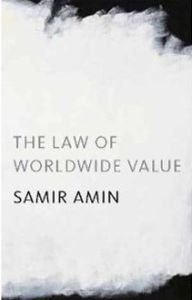
In his new extensively revised and expanded edition of this book originally published as The Law of Value and Historical Materialism Samir Amin suggests new approaches to Marxian analysis of the crisis of the late capitalist system of generalized financialized and globalized oligopolies following on the financial collapse of 2008.
Considering that Marx\'s Capital written before the emergence of imperialism as a decisive factor in capitalist accumulation could provide no explanation for the persistent underdevelopment of the countries of the global South Amin advances several important theoretical concepts extending traditional Marxian views of capitalist evolution.
Most strikingly he proposes adding to the model of reproduction in volume II of Capital a Third Department of production devoted to surplus absorption necessitated by the capitalist tendency constantly to produce an economic surplus too large to be realized by the consumption and investment purchases generated within Marx\'s original two department model.
Equally interesting is his theoretical concept of imperialist rent derived from the scaling of radically different wages paid for the same labor in countries of the North and the South whose effect has been to provide Northern capital with sufficient profits to permit it to pacify for a long period its conflict with the Northern proletariat. To account for this new type of rent he extends the Marxian law of value in the form of a law of globalized value whose operations determine such changes in the polarized world system as the industrial growth of many Third World nations within the global imperialist context. (jacket)
